
December 20, 2023 NHTSA CAMPAIGN NUMBER: 23V865000
An air bag that does not deploy during a crash increases the risk of injury.
NHTSA Campaign Number: 23V865
Manufacturer Toyota Motor Engineering & Manufacturing
Components AIR BAGS
Potential Number of Units Affected 999,901
Summary
Toyota Motor Engineering & Manufacturing (Toyota) is recalling certain 2020-2021 Avalon, Avalon Hybrid, Corolla, Highlander, Highlander Hybrid, RAV4, RAV4 Hybrid, Lexus ES350, Lexus RX350, Lexus RX450H, 2021 Sienna Hybrid, Lexus ES250, 2020-2022 Camry, Camry Hybrid, and ES300H vehicles. A short circuit may develop in the Occupant Classification System (OCS) sensor, preventing the front passenger air bag from deploying.
Remedy
Dealers will inspect and replace the sensor as necessary, free of charge. Owner notification letters are expected to be mailed February 4, 2024. Owners may contact Toyota customer service at 1-800-331-4331. Toyota’s number for this recall is 23TB15/23TA15 Lexus 23LB03/23LA03.
Notes
Owners may also contact the National Highway Traffic Safety Administration Vehicle Safety Hotline at 1-888-327-4236 (TTY 1-800-424-9153), or go to www.nhtsa.gov.
Check if your Vehicle has a Recall
Identification of Involved Vehicles and Affected Components:
Based on production records, we have determined the involved vehicle population as in the table below.
| Make/Car Line | Model Year | Manufacturer | Production Period |
| Toyota / Avalon | 2020-2021 | TMMK | July 2, 2020 through April 20, 2021 |
| Toyota / Avalon Hybrid | July 6, 2020 through May 7, 2021 | ||
| Toyota / Camry | 2020-2022 | TMMK | July 1, 2020 through November 9, 2021 |
| Toyota / Camry Hybrid | July 6, 2020 through September 21, 2021 | ||
| Toyota / Corolla | 2020-2021 | TMMMS | May 29, 2020 through March 3, 2021 |
| Toyota / Highlander | 2020-2021 | TMMI | May 20, 2020 through September 30, 2021 |
| Toyota / Highlander Hybrid | June 4, 2020 through September 29, 2021 | ||
| Toyota / RAV4 | 2020-2021 | TMMC | June 8, 2020 through May 25, 2021 |
| Toyota / RAV4 Hybrid | June 8, 2020 through November 12, 2021 | ||
| Toyota / Sienna Hybrid | 2021 | TMMI | October 13, 2020 through March 30, 2021 |
| Lexus / ES250 | 2021 | TMMK | August 5, 2020 through April 16, 2021 |
| Lexus / ES350 | 2020-2021 | July 2, 2020 through April 16, 2021 | |
| Lexus / ES300h (Hybrid) | 2020-2022 | July 6, 2020 through September 21, 2021 | |
| Lexus / RX350 | 2020-2021 | TMMC | June 12, 2020 through March 5, 2021 |
| Lexus / RX450h (Hybrid) | June 15, 2020 through March 4, 2021 |
| Applicability | Part Number | Part Name | Component Description |
| MY2020-2021
Toyota / Avalon, Avalon Hybrid, Corolla, Highlander, Highlander | 89105-0E040 | SENSOR SUBASSY, WEIGHT DETECTOR, FR IN
| OCS sensor
|
| MY2020-2022
Lexus / ES250, ES350, ES300h | |||
| MY2021 | |||
| MY2020-2021
Toyota / Avalon, Avalon Hybrid, Corolla, Highlander, Highlander | 89107-0E040 | SENSOR SUBASSY, WEIGHT DETECTOR, RR IN | |
| MY2020-2022
Lexus / ES250, ES350, ES300h | |||
| MY2021 |
Note:
(1) Although the involved vehicles are within the above production period range, not all vehicles in this range were sold in the U.S.
(2) This issue only affects the vehicles equipped with a front passenger seat that contains Occupant Classification System (OCS) sensors which may have been manufactured in a specific period at a certain supplier described in this report. Other Toyota or Lexus vehicles sold in the U.S. are not equipped with those OCS sensors.
Total Number of Vehicles Potentially Involved:
| Toyota Avalon | : 9,078 |
| Toyota Avalon Hybrid | : 5,762 |
| Toyota Camry | : 202,513 |
| Toyota Camry Hybrid | : 27,093 |
| Toyota Corolla | : 92,746 |
| Toyota Highlander | : 134,861 |
| Toyota Highlander Hybrid | : 58,054 |
| Toyota RAV4 | : 249,772 |
| Toyota RAV4 Hybrid | : 76,750 |
| Toyota Sienna Hybrid | : 35,297 |
| Lexus ES250 | : 5,374 |
| Lexus ES350 | : 20,252 |
| Lexus ES300h Hybrid | : 7,554 |
| Lexus RX350 | : 63,766 |
| Lexus RX450h Hybrid | : 11,029 |
| Total | : 999,901 |
Percentage of Vehicles Estimated to Actually Contain the Defect:
Based on the supplier investigation of its manufacturing process, it is estimated that approximately 0.2% of the affected parts could have been manufactured with a cracked capacitor as described in Section 5 below. However, as the NHTSA manufacturer portal requires an integer value be entered, Toyota has entered the value “1” in response to this question in the portal. For the purpose of this report, “1” means “0.2%”.
Description of Problem:
The subject vehicles are equipped with a front passenger seat that contains Occupant Classification System (OCS) sensors which provide input to the Supplemental Restraint System(SRS) to determine the deployment strategy of the front passenger airbag, depending on the occupant load. There is a possibility that, during the production process in a specific period at a certain supplier, the OCS sensor Printed Circuit Board (PCB) became deformed, causing a crack to form in a capacitor, which can allow moisture to enter the capacitor over time andresult in a short circuit. If this occurs, the SRS warning lamp will illuminate, the “Passenger Airbag OFF” lamp will illuminate, Multi-Information Display (MID) message will display, andthe front passenger airbag may not deploy in certain crashes as designed, increasing the risk of injury to an occupant in the seat.
Chronology of Principal Events:
Late November 2020 – May 2021
Toyota received three dealer reports indicating SRS malfunction was detected. In each case, the technicians found diagnostic trouble codes related to an OCS sensor malfunction.
Toyota was able to recover and inspect two sets of parts at the supplier. For one set, the supplier did not find any issues with the part. On the other set, the supplier found a front OCS sensor had a short circuit which the supplier indicated may have been caused by items being shoved under the seat, damaging the sensor.
June 2021 – March 2022
Toyota received additional field reports and warranty claims about SRS malfunctions related to an OCS sensor. Parts from these vehicles were recovered and sent to the supplier for further investigation. The supplier found that the sensors had developed a crack in a specific capacitor on the PCB. The production dates of these boards corresponded with a temporary PCB material change at a sub-supplier due to a natural disaster. It was hypothesized that this material change could affect board rigidity. The supplier performed stress analysis tests on the subject parts and confirmed a difference in board rigidity between the original PCB and the PCB with the different material.
In parallel with the analysis of board rigidity, available field data were reviewed. It was determined that the OCS malfunctions were occurring in parts produced by the supplier at the North American manufacturing plant only, even though the same temporary boards were used at a manufacturing plant in Japan. The supplier began investigating the two OCS sensor manufacturing processes, and differences relating to the hot-melt process, which covers the PCB with resin, were found. The process settings in the North America plant had a lower resin temperature and a higher resin injection speed that could affect the amount of PCB strain induced during the process and result in a cracked capacitor that is not detectable at the supplier’s final inspection.
April 2022 – May 2022
The supplier performed environmental tests to identify the mechanism of how the cracked capacitor could lead to a short circuit. It was found that the resin on the PCB can absorb moisture over time, which could enter the cracked portion, resulting in a short circuit.
The supplier then initiated studies to determine how many failures were likely to continue to occur in the field. The supplier’s failure rate estimate predicted that the number of failures would be small considering the vehicle population, and most OCS sensors produced with the cracked capacitor had already failed in the field and had been covered by warranty. Based on the supplier’s testing and estimate, Toyota continued field monitoring and parts collection for further analysis.
June 2022 – July 2022
As a result of additional field occurrences and further analysis of collected parts, the supplier observed that PCB thickness had a larger variation than what was known during the original estimate, which could increase the boards’ susceptibility to a cracked capacitor. Based on these observations, refinements were made to the estimate. Considering this second analysis, Toyota still believed the OCS malfunction was one of early failure, with nearly all failures occurring within the warranty period, and continued field monitoring and parts collection for further analysis.
August 2022 – December 2023
As the warranty claims continued to increase and were nearing the number of estimated failures, Toyota continued to inspect recovered parts and confirm that the failures were due to the cracked capacitor with a short circuit resulting from moisture intrusion. As the failure rate in the field was projected to exceed the supplier’s estimates, it was judged the OCS malfunctions may not all be early failures.
December 14, 2023
Based on the results of the above investigation and the field monitoring, Toyota decided to conduct a voluntary safety recall campaign for the vehicles identified above.
As of December 14, 2023, based on a diligent review of records, Toyota’s best engineering judgement is there are 27 Toyota Field Technical Reports (received between June 2, 2021, and June 16, 2023) and 1,194 warranty claims that have been received from U.S. sources that relate or may relate to this condition which were considered in the decision to submit this report.
Description of Corrective Repair Action:
All known owners of the subject vehicles will be notified by first class mail to return their vehicles to Toyota and Lexus dealers. The dealers will inspect the OCS sensors and, if necessary, replace them with an improved one at no cost.
Reimbursement Plan for pre-notification remedies
The owner letter will instruct vehicle owners who have paid to have this condition remedied prior to this campaign to seek reimbursement pursuant to Toyota’s General Reimbursement Plan.
Recall Schedule:
Notifications to owners of the affected vehicles will occur by February 18, 2024. A copy of the draft owner notification will be submitted as soon as it is available.
Distributor/Dealer Notification Schedule:
Notifications to distributors/dealers will be sent on December 20, 2023. Copies of dealer communications will be submitted as they are issued.
Manufacturer’s Campaign Number:
Toyota [Interim / Remedy] 23TB15 / 23TA15
Lexus [Interim / Remedy] 23LB03 / 23LA03
SAFETY RECALL 23TA15 – Passenger Airbag May Not Deploy – 2020-2022 Toyota
SAFETY RECALL 23LA03 – Passenger Airbag May Not Deploy – 2020-2022 Lexus
30 Affected Products
Vehicles
| MAKE | MODEL | YEAR |
| LEXUS | ES | 2020-2021 |
| LEXUS | ES HYBRID | 2020-2022 |
| LEXUS | RX | 2020-2021 |
| LEXUS | RX HYBRID | 2020-2021 |
| TOYOTA | AVALON | 2020-2021 |
| TOYOTA | AVALON HYBRID | 2020-2021 |
| TOYOTA | CAMRY | 2020-2022 |
| TOYOTA | CAMRY HYBRID | 2020-2022 |
| TOYOTA | COROLLA | 2020-2021 |
| TOYOTA | HIGHLANDER | 2020-2021 |
| TOYOTA | HIGHLANDER HYBRID | 2020-2021 |
| TOYOTA | RAV4 | 2020-2021 |
| TOYOTA | RAV4 HYBRID | 2020-2021 |
| TOYOTA | SIENNA HYBRID | 2021 |
5 Associated Documents
Recall Acknowledgement
RCAK-23V865-8826.pdf 698.387KB
Defect Notice 573 Report
RCLRPT-23V865-7819.PDF 226.481KB
Manufacturer Notices(to Dealers,etc)
RCMN-23V865-1463.pdf 168.846KB
Miscellaneous Document – Part 573 Defect Information Report
RMISC-23V865-4462.pdf 119.747KB
Manufacturer Notices(to Dealers,etc)
Latest Recalls Documents
For the Latest and Most recent Recall Information Visit the link below…
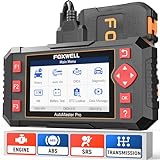
- [Easy to Use—Work Out of the Box] + [FOXWELL 2026 New Version] FOXWELL NT604 Elite scan tool is the 2026 new version from FOXWELL, designed for car owners who want to figure out the cause of issues before fixing car problems by scanning common systems like ABS, SRS, engine, and transmission. The NT604 Elite obd2 scanner diagnostic tool comes with the latest software—no need to waste time downloading software first. Plug the scanner into the OBDII port with OBDII cable to start the diagnosis.
- [Affordable] + [Reliable Car Health Monitor] Will you be confused what happens when the warning light of ABS/SRS/transmission/check engine flashes? Instead of taking your cars to dealership, this FOXWELL scanner will help you do a thorough scanning and detection for your cars and pinpoint the root cause. Note:The device is a diagnostic tool, not a repair tool. To turn off a warning light, you must first physically repair the issue causing it. Only then can the scanner be used to clear the corresponding fault code.
- [5 in 1 Car Diagnostic Scanner] Compared with obd scanners (50-100), NT604 Elite code scanner not only includes their OBDII diagnosis but also serves as ABS/SRS scanner, transmission and check engine code reader. When it’s an odb2 scanner, you can use it to check if your car is ready for annual test through I/M readiness menu. In addition, live data stream, built-in DTC library, data play back and print, all these features are a big plus for it. Note: doesn't support maintenance functions like reset or relearn. For the SRS system, NT604 Elite can read and clear common fault codes not caused by a crash, but crash/collision data cannot be cleared.
- [Fantastic AUTOVIN] + [No extra software fee] Through the AUTOVIN menu, this NT604 Elite car scanner allows you to get your V-IN and vehicle info rapidly, no need to take time to find your V-IN and input one by one. What's more, the NT604 Elite ABS SRS scanner supports 60+ car brands from worldwide (America/Asia/Europe). You don’t need to pay extra software fee. AUTOVIN may not work on some older vehicles or certain vehicle brands. If AUTOVIN fails, please input the vin code manually or go to the Diagnostic Menu to select your vehicle model.
- [Solid protective case KO plastic carrying bag] + [Lifetime update] Almost all same price-level car scanner diagnostic tool only offers plastic bag to hold the scanner.However, NT604 Elite automotive scanner is equipped with solid protective case, preventing your obd2 scanner from damage. Then you don’t need to pay extra money to buy a solid toolbox.
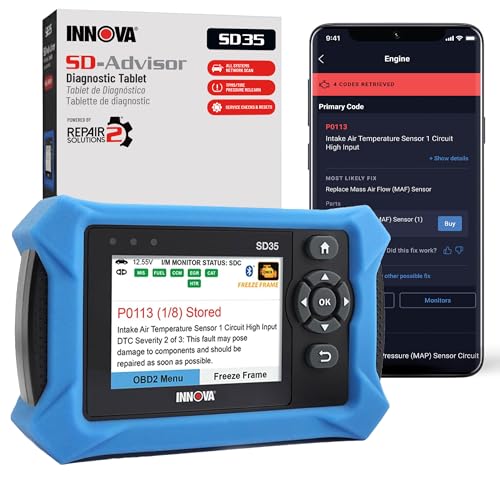
- OBD2 SCANNER FOR ALL SYSTEMS – The INNOVA SD35 is a tablet-based OBD2 scanner designed for advanced diagnostics. Read and clear check engine light, ABS, SRS, and TPMS codes, plus test your car battery and alternator to prevent unexpected failures. Vehicle coverage may vary. Please use Innova’s Coverage Checker to verify compatibility.
- ALL-SYSTEM DIAGNOSTICS & LIVE DATA – Unlike basic code readers, this OBD2 scanner for all vehicles scans engine, transmission, ABS, SRS, and more. Get real-time live data, including RPM, fuel trims, temperature readings, and oxygen sensor performance.
- OBD2 TABLET WITH USER-FRIENDLY INTERFACE – This automotive scan tool features a high-resolution display, making vehicle diagnostics faster and easier.
- ADVANCED TPMS, OIL RESET & SERVICE FUNCTIONS – Perform TPMS sensor checks, oil light reset, and other service resets with ease This professional diagnostic tool provides comprehensive vehicle maintenance capabilities in one device.
- WIDE VEHICLE COVERAGE (1996 & NEWER CARS & TRUCKS) – This OBD2 scanner Bluetooth tablet is compatible with Toyota, Ford, Honda, Chevrolet, Nissan, Dodge, and more. However, feature coverage may vary. Please use Innova's Coverage Checker to verify coverage.
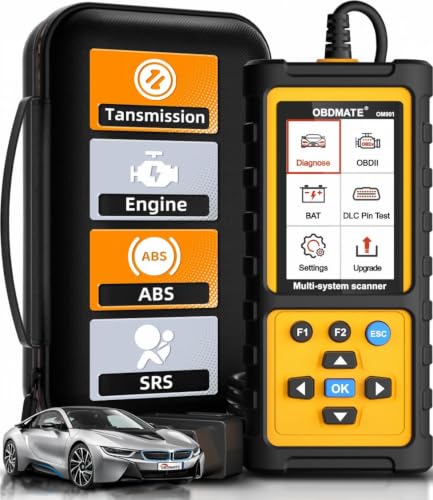
- 【Reset ABS/SRS/Transmission/Engine Lights】 More than an check engine code reader, OBDMATE OM901 obd2 scanner performs comprehensive diagnostics for the 4 most-used systems (ABS/SRS/Engine/Transmission). It quickly clears fault codes, turns off warning lights, read data stream and auto VIN.
- 【3.5" Handheld Scanner with 4 System Diagnose】 3.5" Super large TFT screen equipped displays an intuitive menu and clear readings of various sensors from ABS, SRS, ECM and TCM systems. It arrived with a silicone protective case and hard-shell carrying case, ensuring long-lived durability and drop resistance. The car diagnostic tool is plug-to-play designed, plug it and get diagnosis started without any batteries or updates required.
- 【One-Click I/M Readines&Full OBD2 Functions】 Press F1 to get an intuitive corloured form about whether various emissions-related systems on the vehicle are operating properly. Help you get smog-check ready quickly. OM901 car scanner supports all essential OBD2 functions you need: read & clear codes, view freeze frame, read I/M readiness, retrieve VIN, live data stream (with graphing display), O2 sensor test, onboard monitoring mode, and EVAP leak test.
- 【Battery Voltage Check&DLC Pin Test】 It allows you to monitor battery health by testing current battery voltage. Plus, this obd2 diagnostic tool features DLC 16-PIN test to check current voltage of every pin.
- 【Automotive Scanner Diagnostic Kit】 The package comes with 1 car scanner, 1 USB-type c cable, 1 hard storage bag and 1 user manual(en). Free to update without any hidden fees. 5 languanges available in setting including English, French, Italian, German and Espanish. Valuable and Portable, making it a great tool kit for car owners, DIY enthusiasts, and professional mechanics.
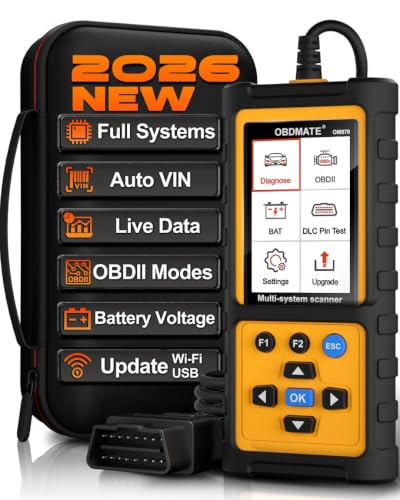
- 【Full Systems Automotive Diagnostic】 More than checking engine, ABS and SRS, OBDMATE OM970 obd2 scanner performs comprehensive diagnostics on all electric modules. It quickly scans and clears fault codes, turns off warning lights, reads live data, and features Auto-VIN technology.
- 【Live Datastream&4-in-1 Graph】 Easily view live sensor data such as RPM, fuel trims, ATF temperature, wheel speed sensor, battery voltage and so on. OM970 scan tool also supports 4-in-1 trend graphing. Spend just 3 minutes to check – and you'll know exactly what's going wrong, helping you avoid hundreds in dealership diagnostic fees.
- 【One-Click I/M Readiness&Full OBD2 Functions】 Press F1 to get an intuitive corloured form about whether your vehicle's emissions-related systems are operating properly. Help you get smog-check ready quickly. OM970 obd2 diagnostic tool supports all essential OBD2 functions you need. Plus, it features battery voltage test and DLC 16-PIN test.
- 【Straightforward Menus with Easy Navigation】 All functions are easy to understand without obscure decriptions. 3.5" Large screen delivers clear readings while keeping one-hand operation. The car diagnostic tool comes with a silicone protective case and a hard-shell carrying case, ensuring long-lived durability and drop resistance.
- 【Budget-Friendly, No Subscriptions, Free Software Updates】 Plug and play: no bluetooth pairing, monthly fees, Wi-Fi connection, or any other troublesome initial settings. OM970 obd2 scanner works out of the box with the latest software. Lifetime free upgrade.
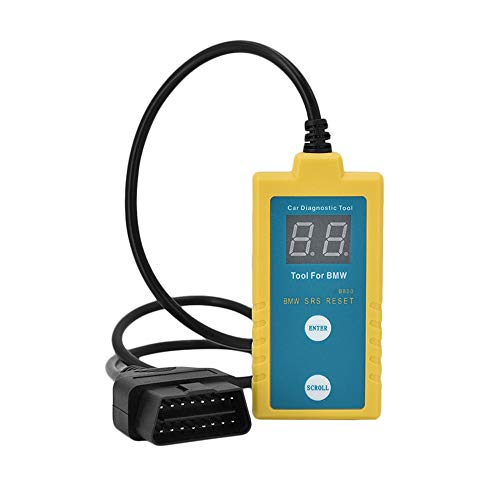
- ✔️【Professional SRS Reset for 1994-2003 BMW】 Designed specifically for classic BMW models (1994-2003). This B800 scanner reads & clears SRS airbag fault codes, turns off the warning light, and saves you a costly dealer visit. Confirmed compatible with: E36, E46 (EXCEPT 2001 330i), E34, E38, E39, Z3, and X5 (E53). NOT compatible with any BMW built before 1994 or after 2003.
- ✔️【Important: Two Different Connection Ports – Read Before Use】 To avoid “not working” issues, please note: For 1994–2000 BMWs (most E36, E34, Z3, early E39), the SRS diagnostic port is a round 20-pin connector under the hood. You MUST use the included 16-pin to 20-pin adapter cable. For 2000–2003 models (late E46, E39, X5), use the standard OBD-II port inside the cabin. Incorrect connection is the #1 reason for “incompatibility” reports.
- ✔️【Read & Clear Fault Codes in Minutes】 Quickly diagnose why your SRS light is on. The scanner accurately reads fault codes from airbag and seatbelt pretensioner systems. With one button press, clear the codes and reset the SRS warning light in seconds. No expensive dealer tools needed.
- ✔️【User-Friendly for DIYers – No Mechanic Required】 Easy operation with an intuitive button layout: ‘Enter’ to confirm, ‘Scroll’ to navigate. The clear LCD screen shows results instantly. Includes a step-by-step manual (revised for clarity) to guide you through the entire reset process.
- ✔️【Reliable Support with 1-Year Warranty】 We stand behind the quality of our B800 scanner. It comes with a 1-Year Hassle-Free Warranty. If you have any questions or need support, please contact us with your Order ID, and our dedicated team will assist you promptly.
SEOCONTENT-START
OMB Control No.: 2127-0004
Part 573 Safety Recall Report 23V-865
The information contained in this report was submitted pursuant to 49 CFR §573
Manufacturer Name : Submission Date :
Toyota Motor Engineering & Manufacturing DEC 20, 2023 NHTSA Recall No. : 23V-865 Manufacturer Recall No. : See attached report
Manufacturer Information :
Manufacturer Name : Toyota Motor Engineering &
Manufacturing
Address : 6565 Headquarters Drive Plano TX 75024
Company phone : 1-800-331-4331
Population :
Number of potentially involved : 999,901 Estimated percentage with defect : 1 %
Vehicle Information :
Vehicle 1 : 2020-2021 Toyota Avalon Vehicle Type :
Body Style :
Power Train : NR
Descriptive Information : Although the involved vehicles are within the above production period range, not all vehicles in this range were sold in the U.S. This issue only affects the vehicles equipped with a front passenger seat that contains Occupant Classification System (OCS) sensors which may have been manufactured in a specific period at a certain supplier described in this report. Other Toyota or Lexus vehicles sold in the U.S. are not equipped with those OCS sensors. Based on the supplier investigation of its manufacturing process, it is estimated that approximately 0.2% of the affected parts could have been manufactured with a cracked capacitor as described in Section 5 below. However, as the NHTSA manufacturer portal requires an integer value be entered, Toyota has entered the value “1” in response to this question in the portal. For the purpose of this report, “1” means “0.2%”. Production Dates : JUL 02, 2020 – APR 20, 2021
VIN Range 1 : Begin : NR End : NR Not sequential Part 573 Safety Recall Report 23V-865 Page 2 Vehicle 2 : 2020-2021 Toyota Avalon Hybrid Vehicle Type :
Body Style :
Power Train : NR
Descriptive Information : Although the involved vehicles are within the above production period range, not all vehicles in this range were sold in the U.S. This issue only affects the vehicles equipped with a front passenger seat that contains Occupant Classification System (OCS) sensors which may have been manufactured in a specific period at a certain supplier described in this report. Other Toyota or Lexus vehicles sold in the U.S. are not equipped with those OCS sensors. Based on the supplier investigation of its manufacturing process, it is estimated that approximately 0.2% of the affected parts could have been manufactured with a cracked capacitor as described in Section 5 below. However, as the NHTSA manufacturer portal requires an integer value be entered, Toyota has entered the value “1” in response to this question in the portal. For the purpose of this report, “1” means “0.2%”. Production Dates : JUL 06, 2020 – MAY 07, 2021
VIN Range 1 : Begin : NR End : NR Not sequential Vehicle 3 : 2020-2022 Toyota Camry Vehicle Type :
Body Style :
Power Train : NR
Descriptive Information : Although the involved vehicles are within the above production period range, not all vehicles in this range were sold in the U.S. This issue only affects the vehicles equipped with a front passenger seat that contains Occupant Classification System (OCS) sensors which may have been manufactured in a specific period at a certain supplier described in this report. Other Toyota or Lexus vehicles sold in the U.S. are not equipped with those OCS sensors. Based on the supplier investigation of its manufacturing process, it is estimated that approximately 0.2% of the affected parts could have been manufactured with a cracked capacitor as described in Section 5 below. However, as the NHTSA manufacturer portal requires an integer value be entered, Toyota has entered the value “1” in response to this question in the portal. For the purpose of this report, “1” means “0.2%”. Production Dates : JUL 01, 2020 – NOV 09, 2021
VIN Range 1 : Begin : NR End : NR Not sequential The information contained in this report was submitted pursuant to 49 CFR §573 Part 573 Safety Recall Report 23V-865 Page 3 Vehicle 4 : 2020-2022 Toyota Camry Hybrid Vehicle Type :
Body Style :
Power Train : NR
Descriptive Information : Although the involved vehicles are within the above production period range, not all vehicles in this range were sold in the U.S. This issue only affects the vehicles equipped with a front passenger seat that contains Occupant Classification System (OCS) sensors which may have been manufactured in a specific period at a certain supplier described in this report. Other Toyota or Lexus vehicles sold in the U.S. are not equipped with those OCS sensors. Based on the supplier investigation of its manufacturing process, it is estimated that approximately 0.2% of the affected parts could have been manufactured with a cracked capacitor as described in Section 5 below. However, as the NHTSA manufacturer portal requires an integer value be entered, Toyota has entered the value “1” in response to this question in the portal. For the purpose of this report, “1” means “0.2%”.
Production Dates : JUL 06, 2020 – SEP 21, 2021
VIN Range 1 : Begin : NR End : NR Not sequential Vehicle 5 : 2020-2021 Toyota Corolla Vehicle Type :
Body Style :
Power Train : NR
Descriptive Information : Although the involved vehicles are within the above production period range, not all vehicles in this range were sold in the U.S. This issue only affects the vehicles equipped with a front passenger seat that contains Occupant Classification System (OCS) sensors which may have been manufactured in a specific period at a certain supplier described in this report. Other Toyota or Lexus vehicles sold in the U.S. are not equipped with those OCS sensors. Based on the supplier investigation of its manufacturing process, it is estimated that approximately 0.2% of the affected parts could have been manufactured with a cracked capacitor as described in Section 5 below. However, as the NHTSA manufacturer portal requires an integer value be entered, Toyota has entered the value “1” in response to this question in the portal. For the purpose of this report, “1” means “0.2%”.
Production Dates : MAY 29, 2020 – MAR 03, 2021
VIN Range 1 : Begin : NR End : NR Not sequential The information contained in this report was submitted pursuant to 49 CFR §573 Part 573 Safety Recall Report 23V-865 Page 4 Vehicle 6 : 2020-2021 Toyota Highlander Vehicle Type :
Body Style :
Power Train : NR
Descriptive Information : Although the involved vehicles are within the above production period range, not all vehicles in this range were sold in the U.S. This issue only affects the vehicles equipped with a front passenger seat that contains Occupant Classification System (OCS) sensors which may have been manufactured in a specific period at a certain supplier described in this report. Other Toyota or Lexus vehicles sold in the U.S. are not equipped with those OCS sensors. Based on the supplier investigation of its manufacturing process, it is estimated that approximately 0.2% of the affected parts could have been manufactured with a cracked capacitor as described in Section 5 below. However, as the NHTSA manufacturer portal requires an integer value be entered, Toyota has entered the value “1” in response to this question in the portal. For the purpose of this report, “1” means “0.2%”.
Production Dates : MAY 20, 2020 – SEP 30, 2021
VIN Range 1 : Begin : NR End : NR Not sequential Vehicle 7 : 2020-2021 Toyota Highlander Hybrid Vehicle Type :
Body Style :
Power Train : NR
Descriptive Information : Although the involved vehicles are within the above production period range, not all vehicles in this range were sold in the U.S. This issue only affects the vehicles equipped with a front passenger seat that contains Occupant Classification System (OCS) sensors which may have been manufactured in a specific period at a certain supplier described in this report. Other Toyota or Lexus vehicles sold in the U.S. are not equipped with those OCS sensors. Based on the supplier investigation of its manufacturing process, it is estimated that approximately 0.2% of the affected parts could have been manufactured with a cracked capacitor as described in Section 5 below. However, as the NHTSA manufacturer portal requires an integer value be entered, Toyota has entered the value “1” in response to this question in the portal. For the purpose of this report, “1” means “0.2%”.
Production Dates : JUN 04, 2020 – SEP 29, 2021
VIN Range 1 : Begin : NR End : NR Not sequential The information contained in this report was submitted pursuant to 49 CFR §573 Part 573 Safety Recall Report 23V-865 Page 5 Vehicle 8 : 2020-2021 Toyota RAV4 Vehicle Type :
Body Style :
Power Train : NR
Descriptive Information : Although the involved vehicles are within the above production period range, not all vehicles in this range were sold in the U.S. This issue only affects the vehicles equipped with a front passenger seat that contains Occupant Classification System (OCS) sensors which may have been manufactured in a specific period at a certain supplier described in this report. Other Toyota or Lexus vehicles sold in the U.S. are not equipped with those OCS sensors. Based on the supplier investigation of its manufacturing process, it is estimated that approximately 0.2% of the affected parts could have been manufactured with a cracked capacitor as described in Section 5 below. However, as the NHTSA manufacturer portal requires an integer value be entered, Toyota has entered the value “1” in response to this question in the portal. For the purpose of this report, “1” means “0.2%”.
Production Dates : JUN 08, 2020 – MAY 25, 2021
VIN Range 1 : Begin : NR End : NR Not sequential Vehicle 9 : 2020-2021 Toyota RAV4 Hybrid Vehicle Type :
Body Style :
Power Train : NR
Descriptive Information : Although the involved vehicles are within the above production period range, not all vehicles in this range were sold in the U.S. This issue only affects the vehicles equipped with a front passenger seat that contains Occupant Classification System (OCS) sensors which may have been manufactured in a specific period at a certain supplier described in this report. Other Toyota or Lexus vehicles sold in the U.S. are not equipped with those OCS sensors. Based on the supplier investigation of its manufacturing process, it is estimated that approximately 0.2% of the affected parts could have been manufactured with a cracked capacitor as described in Section 5 below. However, as the NHTSA manufacturer portal requires an integer value be entered, Toyota has entered the value “1” in response to this question in the portal. For the purpose of this report, “1” means “0.2%”.
Production Dates : JUN 08, 2020 – NOV 12, 2021
VIN Range 1 : Begin : NR End : NR Not sequential The information contained in this report was submitted pursuant to 49 CFR §573 Part 573 Safety Recall Report 23V-865 Page 6 Vehicle 10 : 2021-2021 Toyota Sienna Hybrid Vehicle Type :
Body Style :
Power Train : NR
Descriptive Information : Although the involved vehicles are within the above production period range, not all vehicles in this range were sold in the U.S. This issue only affects the vehicles equipped with a front passenger seat that contains Occupant Classification System (OCS) sensors which may have been manufactured in a specific period at a certain supplier described in this report. Other Toyota or Lexus vehicles sold in the U.S. are not equipped with those OCS sensors. Based on the supplier investigation of its manufacturing process, it is estimated that approximately 0.2% of the affected parts could have been manufactured with a cracked capacitor as described in Section 5 below. However, as the NHTSA manufacturer portal requires an integer value be entered, Toyota has entered the value “1” in response to this question in the portal. For the purpose of this report, “1” means “0.2%”.
Production Dates : OCT 13, 2020 – MAR 30, 2021
VIN Range 1 : Begin : NR End : NR Not sequential Vehicle 11 : 2021-2021 Lexus ES250 Vehicle Type :
Body Style :
Power Train : NR
Descriptive Information : Although the involved vehicles are within the above production period range, not all vehicles in this range were sold in the U.S. This issue only affects the vehicles equipped with a front passenger seat that contains Occupant Classification System (OCS) sensors which may have been manufactured in a specific period at a certain supplier described in this report. Other Toyota or Lexus vehicles sold in the U.S. are not equipped with those OCS sensors. Based on the supplier investigation of its manufacturing process, it is estimated that approximately 0.2% of the affected parts could have been manufactured with a cracked capacitor as described in Section 5 below. However, as the NHTSA manufacturer portal requires an integer value be entered, Toyota has entered the value “1” in response to this question in the portal. For the purpose of this report, “1” means “0.2%”.
Production Dates : AUG 05, 2020 – APR 16, 2021
VIN Range 1 : Begin : NR End : NR Not sequential The information contained in this report was submitted pursuant to 49 CFR §573 Part 573 Safety Recall Report 23V-865 Page 7 Vehicle 12 : 2020-2021 Lexus ES350 Vehicle Type :
Body Style :
Power Train : NR
Descriptive Information : Although the involved vehicles are within the above production period range, not all vehicles in this range were sold in the U.S. This issue only affects the vehicles equipped with a front passenger seat that contains Occupant Classification System (OCS) sensors which may have been manufactured in a specific period at a certain supplier described in this report. Other Toyota or Lexus vehicles sold in the U.S. are not equipped with those OCS sensors. Based on the supplier investigation of its manufacturing process, it is estimated that approximately 0.2% of the affected parts could have been manufactured with a cracked capacitor as described in Section 5 below. However, as the NHTSA manufacturer portal requires an integer value be entered, Toyota has entered the value “1” in response to this question in the portal. For the purpose of this report, “1” means “0.2%”.
Production Dates : JUL 02, 2020 – APR 16, 2021
VIN Range 1 : Begin : NR End : NR Not sequential Vehicle 13 : 2020-2022 Lexus ES300H Vehicle Type :
Body Style :
Power Train : NR
Descriptive Information : Although the involved vehicles are within the above production period range, not all vehicles in this range were sold in the U.S. This issue only affects the vehicles equipped with a front passenger seat that contains Occupant Classification System (OCS) sensors which may have been manufactured in a specific period at a certain supplier described in this report. Other Toyota or Lexus vehicles sold in the U.S. are not equipped with those OCS sensors. Based on the supplier investigation of its manufacturing process, it is estimated that approximately 0.2% of the affected parts could have been manufactured with a cracked capacitor as described in Section 5 below. However, as the NHTSA manufacturer portal requires an integer value be entered, Toyota has entered the value “1” in response to this question in the portal. For the purpose of this report, “1” means “0.2%”.
Production Dates : JUL 06, 2020 – SEP 21, 2021
VIN Range 1 : Begin : NR End : NR Not sequential The information contained in this report was submitted pursuant to 49 CFR §573 Part 573 Safety Recall Report 23V-865 Page 8 Vehicle 14 : 2020-2021 Lexus RX350 Vehicle Type :
Body Style :
Power Train : NR
Descriptive Information : Although the involved vehicles are within the above production period range, not all vehicles in this range were sold in the U.S. This issue only affects the vehicles equipped with a front passenger seat that contains Occupant Classification System (OCS) sensors which may have been manufactured in a specific period at a certain supplier described in this report. Other Toyota or Lexus vehicles sold in the U.S. are not equipped with those OCS sensors. Based on the supplier investigation of its manufacturing process, it is estimated that approximately 0.2% of the affected parts could have been manufactured with a cracked capacitor as described in Section 5 below. However, as the NHTSA manufacturer portal requires an integer value be entered, Toyota has entered the value “1” in response to this question in the portal. For the purpose of this report, “1” means “0.2%”.
Production Dates : JUN 12, 2020 – MAR 05, 2021
VIN Range 1 : Begin : NR End : NR Not sequential Vehicle 15 : 2020-2021 Lexus RX450H Vehicle Type :
Body Style :
Power Train : NR
Descriptive Information : Although the involved vehicles are within the above production period range, not all vehicles in this range were sold in the U.S. This issue only affects the vehicles equipped with a front passenger seat that contains Occupant Classification System (OCS) sensors which may have been manufactured in a specific period at a certain supplier described in this report. Other Toyota or Lexus vehicles sold in the U.S. are not equipped with those OCS sensors. Based on the supplier investigation of its manufacturing process, it is estimated that approximately 0.2% of the affected parts could have been manufactured with a cracked capacitor as described in Section 5 below. However, as the NHTSA manufacturer portal requires an integer value be entered, Toyota has entered the value “1” in response to this question in the portal. For the purpose of this report, “1” means “0.2%”.
Production Dates : JUN 15, 2020 – MAR 04, 2021
VIN Range 1 : Begin : NR End : NR Not sequential The information contained in this report was submitted pursuant to 49 CFR §573 Part 573 Safety Recall Report 23V-865 Page 9 Description of Defect :
Description of the Defect : The subject vehicles are equipped with a front passenger seat that contains Occupant Classification System (OCS) sensors which provide input to the Supplemental Restraint System (SRS) to determine the deployment strategy of the front passenger airbag, depending on the occupant load. There is a possibility that, during the production process in a specific period at a certain supplier, the OCS sensor Printed Circuit Board (PCB) became deformed, causing a crack to form in a capacitor, which can allow moisture to enter the capacitor over time and result in a short circuit. If this occurs, the SRS warning lamp will illuminate, the “Passenger Airbag OFF” lamp will illuminate, Multi- Information Display (MID) message will display, and the front passenger airbag may not deploy in certain crashes as designed, increasing the risk of injury to an occupant in the seat.
FMVSS 1 : NR FMVSS 2 : NR
Description of the Safety Risk : If the short circuit occurs, the SRS warning lamp will illuminate, the
“Passenger Airbag OFF” lamp will illuminate, Multi-Information Display (MID) message will display, and the front passenger airbag may not deploy in certain crashes as designed, increasing the risk of injury to an occupant in the seat.
Description of the Cause : NR Identification of Any Warning NR
that can Occur : Involved Components : Component Name 1 : SENSOR SUB-ASSY, WEIGHT DETECTOR, FR IN
Component Description : OCS Sensor Component Part Number : 89105-0E040 Component Name 2 : SENSOR SUB-ASSY, WEIGHT DETECTOR, RR IN
Component Description : OCS Sensor Component Part Number : 89107-0E040 Supplier Identification : The information contained in this report was submitted pursuant to 49 CFR §573 Part 573 Safety Recall Report 23V-865
Page 10
The information contained in this report was submitted pursuant to 49 CFR §573
Component Manufacturer
Name : Aisin Electronics Illinois, LLC Address : 11200 Redco Drive
Marion Illinois 62959
Country : United States
Chronology :
See attached Part 573 Report
Description of Remedy :
Description of Remedy Program : All known owners of the subject vehicles will be notified by first class mail
to return their vehicles to Toyota and Lexus dealers. The dealers will inspect the OCS sensors and, if necessary, replace them with an improved one at no cost. The owner letter will instruct vehicle owners who have paid to have this condition remedied prior to this campaign to seek reimbursement pursuant to Toyota’s General Reimbursement Plan.
How Remedy Component Differs NR from Recalled Component :
Identify How/When Recall Condition NR was Corrected in Production :
Recall Schedule :
Description of Recall Schedule : Notifications to owners of the affected vehicles will occur by February 18,
2024. A copy of the draft owner notification will be submitted as soon as it is available. Notifications to distributors / dealers will be sent on December 20, 2023. Copies of dealer communications will be submitted as they are issued.
Planned Dealer Notification Date : DEC 20, 2023 – DEC 20, 2023
Planned Owner Notification Date : FEB 04, 2024 – FEB 18, 2024
* NR – Not Reported
**************************************************************************************************************
TOYOTA
Toyota Motor North America, Inc.
Vehicle Safety & Compliance Liaison Office
Mail Stop: W4-2D
6565 Headquarters Drive
Plano, TX 75024 December 20, 2023 DEFECT INFORMATION REPORT 1. Vehicle Manufacturer Name:
Toyota Motor Manufacturing Canada Inc. [“TMMC”]
1055 Fountain Street North, Cambridge, Ontario, Canada N3H 5K2 Toyota Motor Manufacturing, Indiana, Inc. [“TMMI”] 4000 Tulip Tree Drive, Princeton, IN 47670-4000 Toyota Motor Manufacturing, Kentucky, Inc. [“TMMK”] 1001 Cherry Blossom Way, Georgetown, KY, 40324 Toyota Motor Manufacturing Mississippi, Inc. [“TMMMS”] 1200 Magnolia Way, Blue Springs, MS 38828 Affiliated U.S. Sales Company:
Toyota Motor North America, Inc. [“TMNA”] 6565 Headquarters Drive, Plano, TX 75024
Manufacturer of OCS sensor: Aisin Electronics Illinois, LLC
11200 Redco Drive Marion, IL 62959
Phone: +1-618-997-9800
Country of Origin: U.S.A. 2. Identification of Involved Vehicles and Affected Components: Based on production records, we have determined the involved vehicle population as in the table below. Make/Car Line Toyota / Avalon
Toyota / Avalon Hybrid Toyota / Camry Toyota / Camry Hybrid Toyota / Corolla Toyota / Highlander Toyota / Highlander Hybrid Toyota / RAV4 Toyota / RAV4 Hybrid Toyota / Sienna Hybrid Lexus / ES250 Lexus / ES350 Model Year 2020-2021 2020-2022 2020-2021 2020-2021 2020-2021 2021 2021 2020-2021 Manufacturer TMMK TMMK TMMMS TMMI TMMC TMMI TMMK Production Period
July 2, 2020 through
April 20, 2021
July 6, 2020 through May 7, 2021
July 1, 2020 through November 9, 2021
July 6, 2020 through
September 21, 2021
May 29, 2020
through March 3, 2021
May 20, 2020
through September 30, 2021
June 4, 2020 through
September 29, 2021
June 8, 2020 through
May 25, 2021
June 8, 2020 through
November 12, 2021
October 13, 2020 through
March 30, 2021
August 5, 2020 through
April 16, 2021
July 2, 2020 through
April 16, 2021 Lexus / ES300h (Hybrid) Lexus / RX350 Lexus / RX450h (Hybrid) 2020-2022 2020-2021 TMMC July 6, 2020 through
September 21, 2021
June 12, 2020
through March 5, 2021
June 15, 2020
through March 4, 2021 Applicability
MY2020-2021
Toyota / Avalon, Avalon Hybrid, Corolla, Highlander, Highlander Hybrid, RAV4, RAV4 Hybrid Lexus / RX350, RX450h
MY2020-2022
Toyota / Camry, Camry Hybrid Lexus / ES250, ES350, ES300h Part Number 89105-0E040 Part Name SENSOR SUB- ASSY, WEIGHT DETECTOR, FR IN Component Description MY2021
Toyota / Sienna Hybrid MY2020-2021
Toyota / Avalon, Avalon Hybrid, Corolla, Highlander, Highlander Hybrid, RAV4, RAV4 Hybrid Lexus / RX350, RX450h
MY2020-2022
Toyota / Camry, Camry Hybrid Lexus / ES250, ES350, ES300h 89107-0E040 SENSOR SUB- ASSY, WEIGHT DETECTOR, RR IN OCS sensor MY2021
Toyota / Sienna Hybrid Note: (1) Although the involved vehicles are within the above production period range, not all vehicles in this range were sold in the U.S.
(2) This issue only affects the vehicles equipped with a front passenger seat that contains Occupant Classification System (OCS) sensors which may have been manufactured in a specific period at a certain supplier described in this report. Other Toyota or Lexus vehicles sold in the U.S. are not equipped with those OCS sensors. 3. Total Number of Vehicles Potentially Involved: Toyota Avalon : 9,078 Toyota Avalon Hybrid : 5,762 Toyota Camry : 202,513 Toyota Camry Hybrid : 27,093 Toyota Corolla : 92,746
Toyota Highlander : 134,861 Toyota Highlander Hybrid : 58,054 Toyota RAV4 : 249,772
Toyota RAV4 Hybrid : 76,750 Toyota Sienna Hybrid : 35,297 Lexus ES250 : 5,374
Lexus ES350 : 20,252
Lexus ES300h Hybrid : 7,554 Lexus RX350 : 63,766
Lexus RX450h Hybrid : 11,029 Total : 999,901 4. Percentage of Vehicles Estimated to Actually Contain the Defect: Based on the supplier investigation of its manufacturing process, it is estimated that approximately 0.2% of the affected parts could have been manufactured with a cracked capacitor as described in Section 5 below. However, as the NHTSA manufacturer portal requires an integer value be entered, Toyota has entered the value “1” in response to this question in the portal. For the purpose of this report, “1” means “0.2%”. 5. Description of Problem: The subject vehicles are equipped with a front passenger seat that contains Occupant Classification System (OCS) sensors which provide input to the Supplemental Restraint System (SRS) to determine the deployment strategy of the front passenger airbag, depending on the occupant load. There is a possibility that, during the production process in a specific period at a certain supplier, the OCS sensor Printed Circuit Board (PCB) became deformed, causing a crack to form in a capacitor, which can allow moisture to enter the capacitor over time and result in a short circuit. If this occurs, the SRS warning lamp will illuminate, the “Passenger Airbag OFF” lamp will illuminate, Multi-Information Display (MID) message will display, and the front passenger airbag may not deploy in certain crashes as designed, increasing the risk of injury to an occupant in the seat. 6. Chronology of Principal Events: Late November 2020 – May 2021
Toyota received three dealer reports indicating SRS malfunction was detected. In each case, the technicians found diagnostic trouble codes related to an OCS sensor malfunction. Toyota was able to recover and inspect two sets of parts at the supplier. For one set, the supplier did not find any issues with the part. On the other set, the supplier found a front OCS sensor had a short circuit which the supplier indicated may have been caused by items being shoved under the seat, damaging the sensor. June 2021 – March 2022
Toyota received additional field reports and warranty claims about SRS malfunctions related to an OCS sensor. Parts from these vehicles were recovered and sent to the supplier for further investigation. The supplier found that the sensors had developed a crack in a specific capacitor on the PCB. The production dates of these boards corresponded with a temporary PCB material change at a sub-supplier due to a natural disaster. It was hypothesized that this material change could affect board rigidity. The supplier performed stress analysis tests on the subject parts and confirmed a difference in board rigidity between the original PCB and the PCB with the different material. In parallel with the analysis of board rigidity, available field data were reviewed. It was determined that the OCS malfunctions were occurring in parts produced by the supplier at the North American manufacturing plant only, even though the same temporary boards were used at a manufacturing plant in Japan. The supplier began investigating the two OCS sensor manufacturing processes, and differences relating to the hot-melt process, which covers the PCB with resin, were found. The process settings in the North America plant had a lower resin temperature and a higher resin injection speed that could affect the amount of PCB strain induced during the process and result in a cracked capacitor that is not detectable at the supplier’s final inspection. April 2022 – May 2022
The supplier performed environmental tests to identify the mechanism of how the cracked capacitor could lead to a short circuit. It was found that the resin on the PCB can absorb moisture over time, which could enter the cracked portion, resulting in a short circuit. The supplier then initiated studies to determine how many failures were likely to continue to occur in the field. The supplier’s failure rate estimate predicted that the number of failures would be small considering the vehicle population, and most OCS sensors produced with the cracked capacitor had already failed in the field and had been covered by warranty. Based on the supplier’s testing and estimate, Toyota continued field monitoring and parts collection for further analysis. June 2022 – July 2022
As a result of additional field occurrences and further analysis of collected parts, the supplier observed that PCB thickness had a larger variation than what was known during the original estimate, which could increase the boards’ susceptibility to a cracked capacitor. Based on these observations, refinements were made to the estimate. Considering this second analysis, Toyota still believed the OCS malfunction was one of early failure, with nearly all failures occurring within the warranty period, and continued field monitoring and parts collection for further analysis. August 2022 – December 2023
As the warranty claims continued to increase and were nearing the number of estimated failures, Toyota continued to inspect recovered parts and confirm that the failures were due to the cracked capacitor with a short circuit resulting from moisture intrusion. As the failure rate in the field was projected to exceed the supplier’s estimates, it was judged the OCS malfunctions may not all be early failures. December 14, 2023
Based on the results of the above investigation and the field monitoring, Toyota decided to conduct a voluntary safety recall campaign for the vehicles identified above. As of December 14, 2023, based on a diligent review of records, Toyota’s best engineering judgement is there are 27 Toyota Field Technical Reports (received between June 2, 2021, and June 16, 2023) and 1,194 warranty claims that have been received from U.S. sources that relate or may relate to this condition which were considered in the decision to submit this report. 7. Description of Corrective Repair Action: All known owners of the subject vehicles will be notified by first class mail to return their vehicles to Toyota and Lexus dealers. The dealers will inspect the OCS sensors and, if necessary, replace them with an improved one at no cost. Reimbursement Plan for pre-notification remedies
The owner letter will instruct vehicle owners who have paid to have this condition remedied prior to this campaign to seek reimbursement pursuant to Toyota’s General Reimbursement Plan. 8. Recall Schedule: Notifications to owners of the affected vehicles will occur by February 18, 2024. A copy of the draft owner notification will be submitted as soon as it is available. 9. Distributor/Dealer Notification Schedule: Notifications to distributors/dealers will be sent on December 20, 2023. Copies of dealer communications will be submitted as they are issued. 10. Manufacturer’s Campaign Number: Toyota [Interim / Remedy] 23TB15 / 23TA15
Lexus [Interim / Remedy] 23LB03 / 23LA03
**************************************************************************************************************
**************************************************************************************************************
**************************************************************************************************************
**************************************************************************************************************
**************************************************************************************************************
SEOCONTENT-END
This product presentation was made with AAWP plugin.