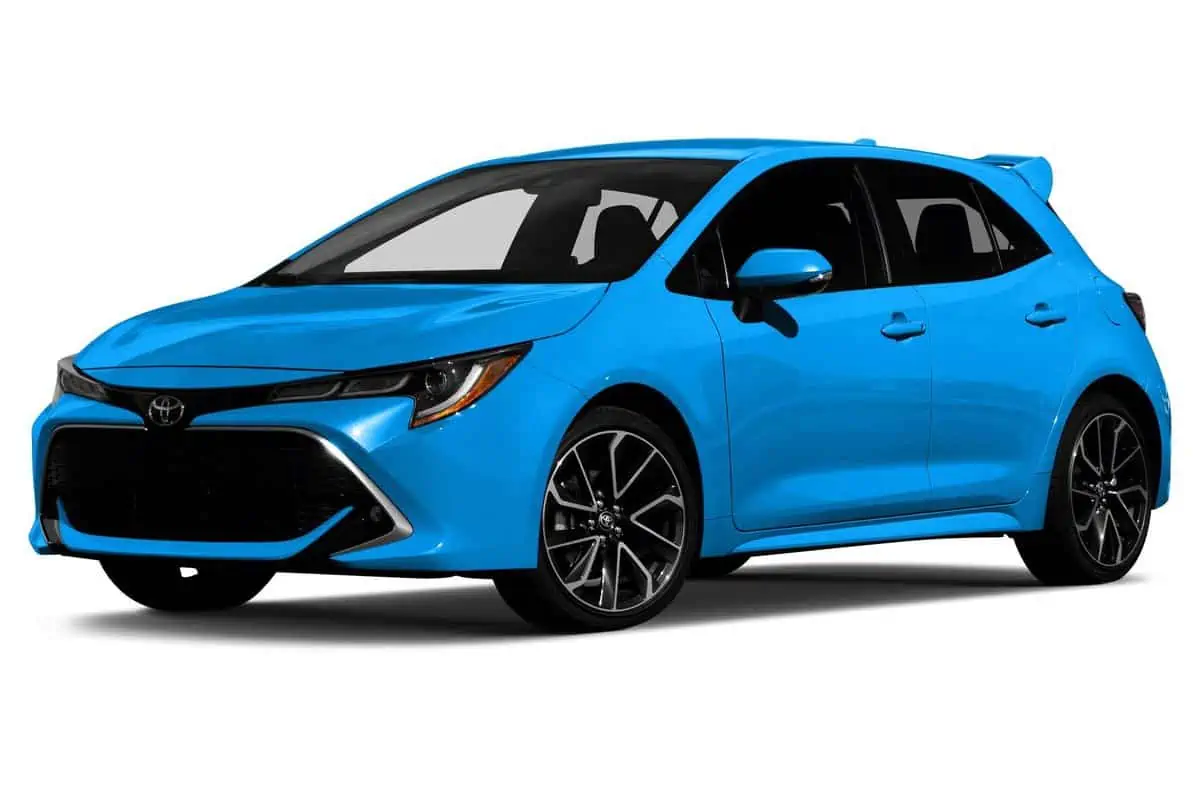
January 17, 2020 NHTSA CAMPAIGN NUMBER: 20V024000
Air Bags/Seat Belt Pretensioners may not Deploy
In the event of a crash, air bags and/or seat belt pretensioners that do not deploy as intended may increase the risk of injury.
NHTSA Campaign Number: 20V024
Manufacturer Toyota Motor Engineering & Manufacturing
Components AIR BAGS
Potential Number of Units Affected 2,891,976
Summary
Toyota Motor Engineering & Manufacturing (Toyota) is recalling certain 2011-2019 Corolla, 2011-2013 Matrix, 2012-2018 Avalon, and 2013-2018 Avalon Hybrid vehicles. During certain crashes, the air bag electronic control unit (ECU) may malfunction, possibly disabling the deployment of the air bags and/or seat belt pretensioners.
Remedy
Toyota will notify owners, and dealers will inspect the ECU and install a noise filter between the air bag control module and its wire harness, as necessary, free of charge. Owners were notified of the safety risk beginning March 2, 2020. A second letter notifying owners of the remedy repair will be mailed between March 16, 2020 and June 27, 2020. Owners may contact Toyota customer service at 1-888-270-9371. Toyota’s numbers for this recall are 20TB03, 20TA03 and 20TA05.
Notes
Owners may also contact the National Highway Traffic Safety Administration Vehicle Safety Hotline at 1-888-327-4236 (TTY 1-800-424-9153), or go to www.safercar.gov.
Check if your Vehicle has a Recall
◄ IMPORTANT UPDATE ►
The attached Dealer Letter has been updated. Refer to the details below.
| DATE | TOPIC |
| 04/22/2020 |
|
| 03/23/2020 | Added Step to Flow Chart under Warranty Reimbursement Procedure |
| 03/17/2020 | Added Toyota Customer Vehicle Offsite Storage Form |
The most recent update in the attached Dealer Letter will be highlighted with a red box.
Please review this notification with your staff to assure that all relevant personnel have been briefed regarding this subject.
Thank you for your cooperation.
Original Publication Date: March 12, 2020
To: All Toyota Dealer Principals, General Managers, Service Managers, and Parts Managers
SAFETY RECALL 20TA03 (Interim Notice 20TB03) – Remedy Notice
Certain 2011 – 2019 Model Year Corolla
Certain 2011 – 2013 Model Year Matrix
Certain 2012 – 2018 Model Year Avalon
Certain 2013 – 2018 Model Year Avalon Hybrid
Incomplete or Nondeployment of Airbags and/or Seat Belt Pretensioners May Occur
NHTSA Recall No. 20V-024
| Model / Years | Production Period | Approximate Total Vehicles | Approximate Stop Sale Dealer Inventory |
| Corolla 2011 – 2019 | Late November 2010 – Late February 2019 | 2,577,000 | 30 |
| Matrix 2011 – 2013 | Early December 2010 – Mid-June 2013 | 10,200 | 0 |
| Avalon 2012 – 2018 | Mid-May 2012 – Mid-April 2018 | 241,900 | 0 |
| Avalon HV 2013 – 2018 | Late May 2012 – Late March 2018 | 63,800 | 3 |
 | STOP! DO NOT SELL NEW VEHICLES IN DEALER INVENTORY.
Refer to Dealer Inventory Procedures section for more details. | |
On January 17, 2020, Toyota filed a Defect Information Report (DIR) with the National Highway Traffic Safety Administration (NHTSA) informing the agency of our intent to conduct a voluntary Safety Recall on certain 2011 – 2019 model year Corolla, 2011 – 2013 model year Matrix, 2012 – 2018 model year Avalon and 2013 – 2018 Avalon Hybrid vehicles.
Condition
The subject vehicles may be equipped with an electronic control unit (ECU) from a specific supplier that is designed to receive signals from crash sensors and deploy the airbags and seat belt pretensioners. The ECU may not have adequate protection against certain electrical noise that can occur in certain crashes, such as severe underride crashes. This can lead to incomplete or nondeployment of the airbags and/or seat belt pretensioners. Airbag and seat belt pretensioners that do not deploy as intended can increase the risk of injury in a crash.
Remedy
Toyota has sufficient parts to begin a phased implementation of the remedy. Any authorized Toyota dealer will, in most cases, install a noise filter between the airbag control module and its wire harness. In some cases, Toyota dealers may inspect the ECU to determine if the noise filter is necessary before installing it. The remedy will be at no cost to vehicle owners. Refer to the table below to determine the remedy status and remedy campaign designation for vehicles involved in this Safety Recall.
| Phase | Model / Years | Approximate Total Vehicles | Remedy Status | Remedy Campaign Designation |
| 1 | Corolla 2014 – 2019 | 528,000 | Remedy Available* | 20TA03 |
| 2 | Corolla 2011 – 2012 | 112,000 | Remedy Available* | 20TA05** |
| Corolla 2011 – 2013 | 616,000 | Remedy Available* | 20TA03 | |
| Matrix 2011 – 2013 | 10,200 | |||
| Avalon 2012 – 2018 | 241,900 | |||
| Avalon HV 2013 – 2018 | 63,800 | |||
| Corolla 2014 – 2019 | 1,321,000 |
*Only a portion of the 2014 – 2019 model year Corolla vehicles covered by this Safety Recall are included in the phase 1 remedy.
**Certain 2011-2012 Corolla vehicles will require an inspection of the ECU to determine if noise filter installation is necessary. These vehicles will be loaded to campaign designation 20TA05. A separate Dealer Letter and Technical Instructions will be available at the time of phase 2 remedy launch.
Covered Vehicles
There are approximately 2,892,900 vehicles covered by this Safety Recall. Approximately 50,000 vehicles involved in this Safety Recall were distributed to Puerto Rico.
Owner Letter Mailing Date
Toyota notified customers involved in phase 1 in mid-March 2020 informing them that the remedy is available. Toyota also mailed an interim owner letter to phase 2 customers beginning early-March 2020. Phase 2 customers will be notified, beginning in late April 2020, that the remedy is now available for their vehicles. Samples of the owner notification letters have been included for your reference.
Toyota makes significant effort to obtain current customer name and address information from each state through industry resources when mailing owner letters. In the event your dealership receives a notice for a vehicle that was sold prior to the Safety Recall announcement, it is the dealership’s responsibility to forward the owner letter to the customer who purchased the vehicle.
Please note that only owners of the covered vehicles will be notified. If you are contacted by an owner who has not yet received a notification, please verify eligibility by confirming through TIS prior to performing repairs. Dealers should perform the repair as outlined in the Technical Instructions found on TIS.
Dealer Inventory Procedures
New Vehicles in Dealership Inventory
There are approximately 33 vehicles in new dealer inventory as of January 21, 2020.
| Under Title 49, Section 30112 of the United States Code, a dealer cannot sell, offer for sale, or introduce or deliver for introduction in interstate commerce a new motor vehicle when it is aware that the vehicle does not comply with an applicable Federal Motor Vehicle Safety Standard or contains a defect related to motor vehicle safety. Further, 49 Code of Federal Regulations §577.13 requires us to provide the following advisory: It is a violation of Federal law for a dealer to deliver a new motor vehicle or any new or used item of motor vehicle equipment (including a tire) covered by this notification under a sale or lease until the defect or noncompliance is remedied.
Toyota reimburses dealers for flooring costs associated with new vehicles held in dealership inventory until the recall remedy becomes available. Toyota provides these flooring reimbursements at 60-day intervals. Toyota reserves the right to withhold or charge-back any flooring reimbursement funds that may have been paid to the dealer if it determines that a new vehicle subject to a safety recall was sold without first being remedied. |
| Vehicle Safety Recall completion should always be verified through TIS. We request your assistance to ensure involved vehicles are identified and not delivered prior to performing the remedy. | |
NOTE:
- New vehicles in dealer inventory subject to a Safety Recall must be remedied before delivery into commerce under a sale or lease. Dealer-to-dealer trades as well as vehicle sales between dealers should not be made until a vehicle is remedied.
- Dealers can identify if any of their new and used inventory has any open campaigns in the Vehicle Inventory Summary available in Dealer Daily (Non SET and GST dealers: https://dealerdaily.toyota.com/). The Vehicle Inventory Summary may take up to 4 hours to populate information for newly launched campaigns.
Inspection Reminder Mirror Hang Tags for Covered Vehicles in New Dealer Stock
To easily recognize vehicles involved in this Safety Recall, each dealership should utilize Inspection Reminder Hang Tags. Inside the vehicle’s glove box are stickers containing the VIN. Apply one of these stickers to the hang tag and install the hang tag in the vehicle. A sample copy of the Inspection Reminder Hang Tag has been included for your reference.
Toyota Version Below

| Part Number | Description | Quantity |
| 00411-140003 | Inspection Mirror Hang Tag | 25 Per Pack |
NOTE: Dealerships can order hang tags from the Material Distribution Center (MDC).
Pre-Owned Vehicles in Dealer Inventory
To ensure customer satisfaction, Toyota requests that dealers complete this Safety Recall on any used vehicles currently in dealer inventory that are covered by this Safety Recall prior to customer delivery. However, if the campaign cannot be completed (for example, due to remedy parts availability), delivery of a covered vehicle is acceptable if disclosed to the customer that the vehicle is involved in a Safety Recall.
Toyota expects dealers to use the attached Customer Contact and Vehicle Disclosure Form to obtain vehicle buyer information. Dealers are expected to provide a copy of the completed form, along with the most current FAQ, to the vehicle buyer. Toyota and the dealer may use this information to contact the customer when the remedy becomes available.
Keep the completed form on file at the dealership and send a copy to quality_compliance@toyota.com. In the subject line of the email state “Disclosure Form 20TA03” and include the VIN.
NOTE: Dealers can identify if any of their new and used inventory has any open campaigns in the Vehicle Inventory Summary available in Dealer Daily (Non SET and GST dealers: https://dealerdaily.toyota.com/). The Vehicle Inventory Summary may take up to 4 hours to populate information for newly launched campaigns.
Toyota Certified Used Vehicle (TCUV)
The TCUV policy prohibits the certification of any vehicle with an outstanding Safety Recall, Special Service Campaign, or Limited Service Campaign. Thus, no affected units are to be designated, sold, or delivered as a TCUV until all applicable Safety Recalls, Special Service Campaigns, and Limited Service Campaigns have been completed on that vehicle.
Toyota Rent-A-Car (TRAC) & Service Loaners
Toyota requests that dealers remove all TRAC and Service Loaner vehicles from service that are covered by a Safety Recall unless the defect has been remedied.
Customer Handling, Parts Ordering, and Remedy Procedures
Customer Contacts
Customers who receive the owner letter may contact your dealership with questions regarding the letter and/or the Safety Recall. Please welcome them to your dealership and answer any questions that they may have. A Q&A is provided to assure a consistent message is communicated.
Customers with additional questions or concerns are asked to please contact the Toyota Customer Experience Center (1-888-270-9371) – Monday through Friday, 7:00 am to 7:00 pm, Saturday 7:00 am to 4:30 pm Central Time.
Salvage Title Vehicles
Every attempt should be made to complete an open Safety Recall when circumstances permit, unless noted otherwise in the Safety Recall dealer letter.
For complete details on this policy, refer to Toyota Warranty Policy 4.17, “What Is Not Covered by The Toyota New Vehicle Limited Warranty”.
Media Contacts
It is imperative that all media contacts (local and national) receive a consistent message. In this regard, all media contacts must be directed to Tania Saldana (859) 815-9968 in Toyota Corporate Communications.
Please do not provide this number to customers. Please provide this contact only to media.
Parts Ordering Process – Non SET and GST Parts Ordering Process
It is possible that parts for this campaign are either required to be ordered in Campaign Part Order Request (CPOR) on Service Lane, or have been placed on Manual Allocation Control (MAC) due to potential limited part availability. Please check the CPOR/MAC report on Dealer Daily for the most up-to-date parts ordering information.
All Safety Recall, Service Campaign (SSC/LSC) parts are eligible for the Monthly Parts Return Program. Please refer to PANT Bulletin 2011-087 for campaign parts that are currently returnable under the Monthly Parts Return Program and for additional details.
| Part Number | Description | Quantity |
| 04009-98112 | Airbag Harness Kit | 1 |
Technician Training Requirements
The repair quality of covered vehicles is extremely important to Toyota. All dealership technicians performing this repair are required to successfully complete the most current version of the E-Learning course “Safety Recall and Service Campaign Essentials”. To ensure that all vehicles have the repair performed correctly; technicians performing this repair are required to currently hold at least one of the following certification levels:
- Expert (Electrical or Hybrid)
- Master
- Master Diagnostic Technician
Always check which technicians can perform the repair by logging on to https://www.uotdealerreports.com. It is the dealership’s responsibility to select technicians with the above certification level or greater to perform this recall repair. Carefully review your resources, the technician skill level, and ability before assigning technicians to this repair. It is important to consider technician days off and vacation schedules to ensure there are properly trained technicians available to perform this repair at all times.
Remedy Procedures
Refer to TIS for Technical Instructions on repair. Conduct all non-completed Safety Recalls and Service Campaigns on the vehicle during the time of appointment.
Repair Quality Confirmation
The repair quality of covered vehicles is extremely important to Toyota. To help ensure that all vehicles have the repair performed correctly, please designate at least one associate (someone other than the individual who performed the repair) to verify the repair quality of every vehicle prior to customer delivery.
Post Repair Quality Checksheet
The Technical Instructions will direct you to a website as part of the repair quality confirmation procedure. For your reference, the website and default password are listed below:
Default Password: XXXXX
Each dealer only has a single account; please ensure that the reset password is communicated to all technicians and dealer associates that will be utilizing this website.
Parts Recovery Procedures
All parts replaced as part of this Safety Recall must be turned over to the parts department until appropriate disposition is determined. The parts department must retain these parts until notification via the Parts Recovery System (PRS) is received indicating whether to ship or scrap the parts. These parts are utilized by various departments for defect analysis, quality control analysis, product evaluation, as well as other purposes.
To help minimize dealer storage challenges, Toyota recommends that dealers:
- File the campaign claim accurately and promptly. The time a dealer is required to hold parts is based on when the campaign claim is paid by Toyota.
- Monitor the Warranty Parts Recovery Notifications and Part Scrap Report regularly.
Refer to Warranty Policies 9.3 and 9.6 for additional details.
Warranty Reimbursement Procedures
Loaner Vehicle or Alternative Transportation Reimbursement Procedure
For customers who request a loaner vehicle or alternative transportation through Toyota Rent-A-CAR (TRAC) during the interim phase, a loaner vehicle or alternative transportation can be claimed for $35 per day.
If a customer is not eligible for a loaner or alternative transportation, the customer can contact Customer Experience Center for further assistance.
| Op Code (File under designation 20TB03) | Description |
| TB03R1 | Vehicle Rental 1-30 Days |
| TB03R2 | Vehicle Rental 31-60 Days |
| TB03R3 | Vehicle Rental 61-90 Days |
NOTE:
- Rental invoice MUST be attached to all rental claims. These claims may be subject to debit if rental invoice is not attached.
- Rentals that exceed the maximum allowable daily rate will require DSPM authorization per the Toyota Transportation Assistance Policy (TTAP).
- Dealers will be allowed to file these Op Codes up to 90 days after the final phase has launched into remedy. After that time, no claims for alternative transportation reimbursement will be accepted.
Warranty Reimbursement Procedure
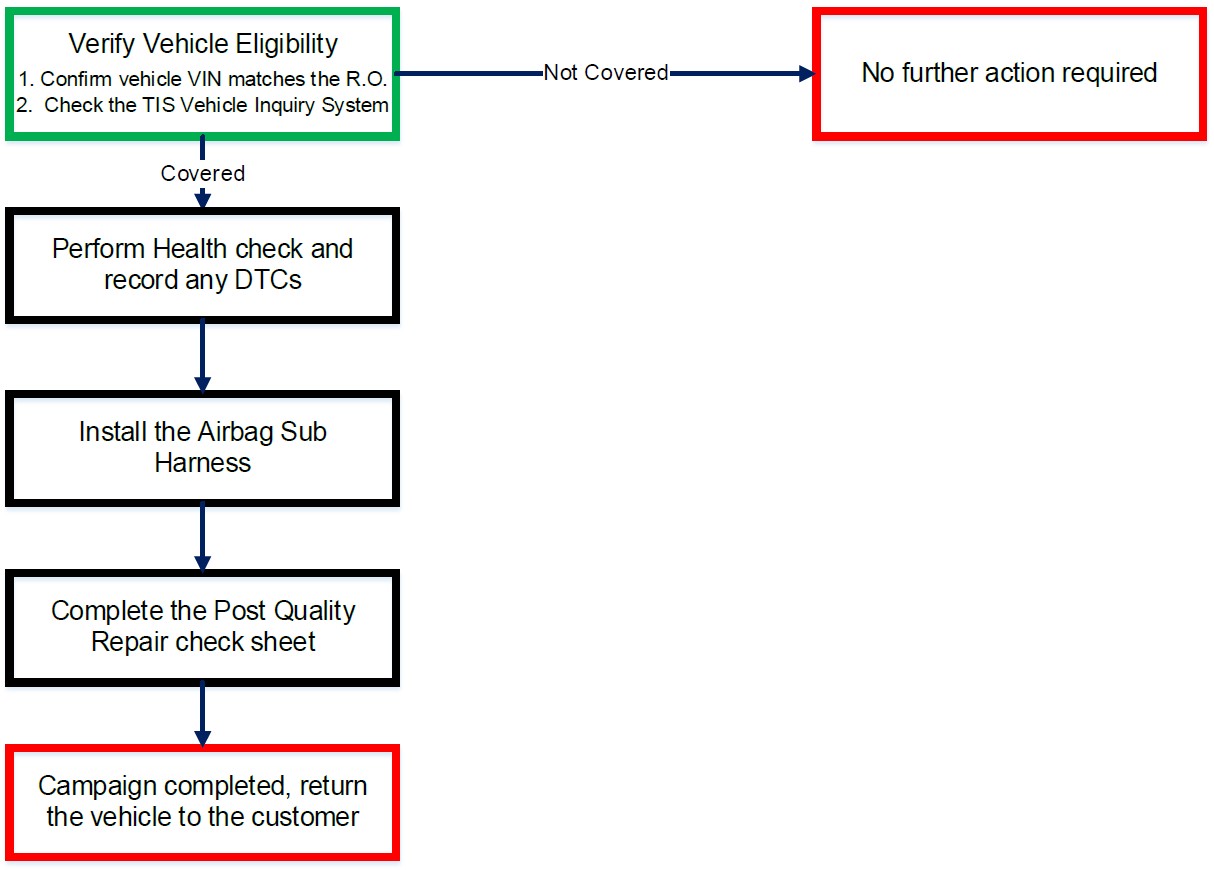
| Op Code | Description | Flat Rate Hours |
| 2TA031 | Install Airbag Harness Kit – Corolla & Avalon (2012MY) | 1.1 |
| 2TA032 | Install Airbag Harness Kit – Matrix (w/o rear air duct) | 1.2 |
| 2TA033 | Install Airbag Harness Kit – Matrix (w/rear air duct) | 1.4 |
| 2TA034 | Install Airbag Harness Kit – Avalon/Avalon HV (2013-2018MY) | 1.7 |
- The flat rate times include 0.1 hours for administrative cost per unit for the dealership.
Claim Filing Accuracy and Correction Requests
It is the dealer’s responsibility to file claims correctly for this Safety Recall. This claim filing information is used by Toyota for various government reporting activities; therefore, claim filing accuracy is crucial. If it has been identified that a claim has been filed using an incorrect Op Code or a claim has been filed for an incorrect VIN, refer to Warranty Procedure Bulletin PRO17-03 to correct the claim.
Customer Reimbursement Reimbursement consideration instructions will be included in the owner letter.
Campaign Designation / Phase Decoder
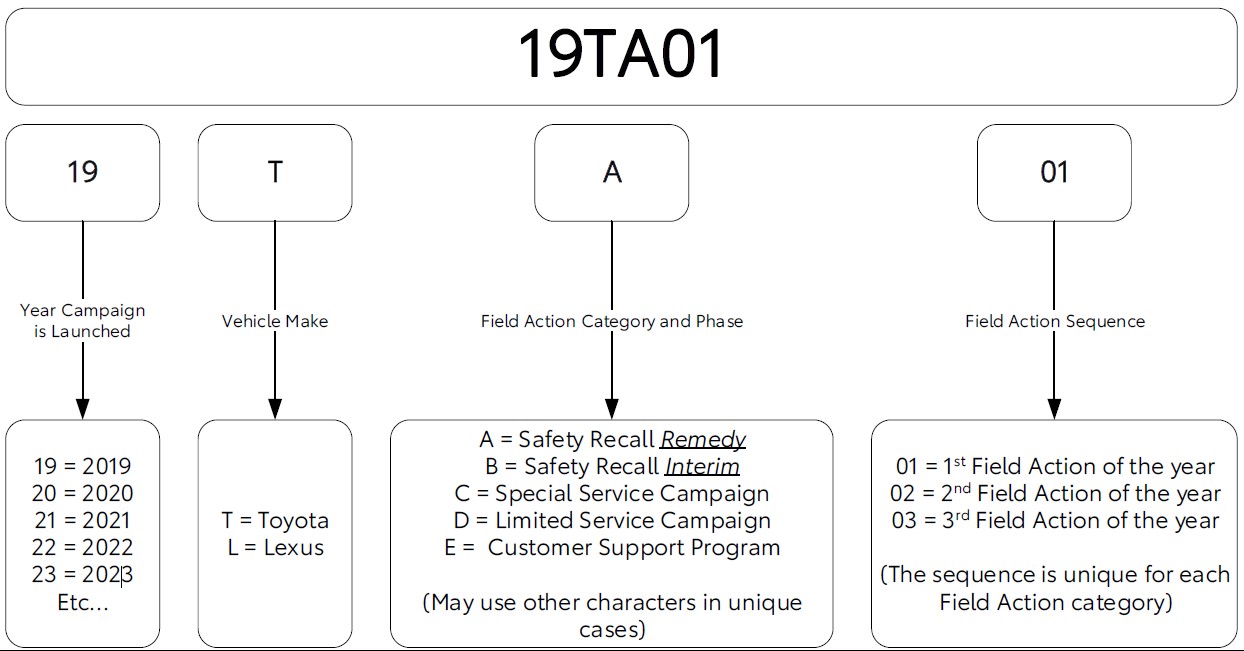 |
| Examples:
19TA01 = Launched in 2019, Toyota, Safety Recall Remedy Phase, 1st Safety Recall Launched in 2019 20TC02 = Launched in 2020, Special Service Campaign, 2nd Special Service Campaign Launched in 2020 21TE05 = Launched in 2021, Customer Support Program, 5th Customer Support Program Launched in 2021 |
Please review this entire package with your Service and Parts staff to familiarize them with the proper step-bystep procedures required to implement this Safety Recall.
Thank you for your cooperation.
TOYOTA MOTOR SALES, U.S.A., INC.
SAFETY RECALL 20TA03 (Interim Notice 20TB03) – Remedy Notice
Certain 2011 – 2019 Model Year Corolla
Certain 2011 – 2013 Model Year Matrix
Certain 2012 – 2018 Model Year Avalon
Certain 2013 – 2018 Model Year Avalon Hybrid
Incomplete or Nondeployment of Airbags and/or Seat Belt Pretensioners May Occur
NHTSA Recall No. 20V-024
Frequently Asked Questions
Original Publication Date: March 12, 2020
◄IMPORTANT UPDATE ► | |
| DATE | TOPIC |
| 04/22/2020 | Q2/A2 table has been updated for phase 2 remedy availability |
The most recent update will be highlighted with a red box.
| Q1: | What is the condition? | |||||||||||||||||||||||||||
| A1:
| The subject vehicles may be equipped with an electronic control unit (ECU) from a specific supplier that is designed to receive signals from crash sensors and deploy the airbags and seat belt pretensioners. The ECU may not have adequate protection against certain electrical noise that can occur in certain crashes, such as severe underride crashes. This can lead to incomplete or nondeployment of the airbags and/or seat belt pretensioners. Airbags and seat belt pretensioners that do not deploy as intended can increase the risk of injury in a crash.
| |||||||||||||||||||||||||||
| Q2: | What is Toyota going to do? | |||||||||||||||||||||||||||
| A2: | Toyota has sufficient parts to begin a phased implementation of the remedy. Any authorized Toyota dealer will, in most cases, install a noise filter between the airbag control module and its wire harness. In some cases, Toyota dealers may inspect the ECU to determine if the noise filter is necessary before installing it. The remedy will be at no cost to vehicle owners. Refer to the table below to determine the remedy status and remedy campaign designation for vehicles involved in this Safety Recall.
*Only a portion of the 2014 – 2019 model year Corolla vehicles covered by this Safety Recall are included in the phase 1 remedy. Any authorized Toyota dealer can determine if the remedy is available or not for a specific 2014 – 2019 Corolla vehicle. **Certain 2011-2012 Corolla vehicles will require an inspection of the ECU to determine if noise filter installation is necessary. These vehicles will be loaded to Toyota systems under campaign designation 20TA05. Toyota notified owners involved in phase 1 remedy in mid-March 2020. Owners involved in phase 2 remedy will be notified by late June 2020.
| |||||||||||||||||||||||||||
| Q3: | Which and how many vehicles are covered by this Safety Recall? | |||||||||||||||||||||||||||
| A3: | There are approximately 2,892,900 vehicles covered by this Safety Recall.
| |||||||||||||||||||||||||||
| Q4: | What if I previously paid for repairs related to this Safety Recall? | |||||||||||||||||||||||||||
| A4: | Reimbursement consideration instructions will be provided in the owner letter.
| |||||||||||||||||||||||||||
| Q5: | How does Toyota obtain my mailing information? | |||||||||||||||||||||||||||
| A5: | Toyota uses an industry provider who works with each state’s Department of Motor Vehicles (DMV) to receive registration or title information, based upon the DMV records. Please make sure your registration or title information is correct.
| |||||||||||||||||||||||||||
| Q6: | What if I have additional questions or concerns? | |||||||||||||||||||||||||||
| A6: | If you have additional questions or concerns, please contact the Toyota Customer Experience Center at 1-888-270-9371 Monday through Friday, 7:00 am to 7:00 pm, Saturday 7:00 am to 4:30 pm Central Time.
|
URGENT SAFETY RECALL
This is an important Safety Recall. The remedy will be performed FREE OF CHARGE to you.
This notice applies to your vehicle:
VIN ABCDEFGH987654321
IMPORTANT SAFETY RECALL (Remedy Notice)
Certain 2011–2019 Model Year Corolla
Certain 2011–2013 Model Year Matrix
Certain 2012–2018 Model Year Avalon
Certain 2013–2018 Model Year Avalon Hybrid
Incomplete or Nondeployment of Airbags and/or Seat Belt Pretensioners May Occur
NHTSA Recall No. 20V-024
Dear <FirstName/LastName>:
This notice is sent to you in accordance with the National Traffic and Motor Vehicle Safety Act. Toyota has decided that a defect, which relates to motor vehicle safety, exists in certain 2011–2019 model year Corolla, certain 2011–2013 model year Matrix, certain 2012–2018 model year Avalon and certain 2013–2018 Avalon Hybrid vehicles.
You received this notice because our records, which are based primarily on state registration and title data, indicate that you are the current owner.
What is the condition?
The subject vehicles are equipped with an electronic control unit (ECU) from a specific supplier that is designed to receive signals from crash sensors and deploy the airbags and seat belt pretensioners. The ECU may not have adequate protection against certain electrical noise that can occur in certain crashes, such as severe underride crashes. This can lead to incomplete or nondeployment of the airbags and/or seat belt pretensioners. Airbag and seat belt pretensioners that do not deploy as intended can increase the risk of injury in a crash.
What Should You Do?
Please contact any authorized Toyota dealer to schedule an appointment to have the remedy performed as soon as possible. The remedy will require a new part to be installed. We recommend you contact your dealer to schedule an appointment in advance to confirm parts availability and minimize your inconvenience.
Your local Toyota dealer will be more than happy to answer any of your questions.
To find a dealer near you, visit www.toyota.com/dealers.
For more information on this and other Safety Recalls, including Frequently Asked Questions, visit www.toyota.com/recall. Input your full 17-digit Vehicle Identification Number (VIN) noted above to review information specific to your vehicle.
If you require further assistance, you may contact the Toyota Customer Experience Center at 1-888-270-9371 Monday through Friday, 7:00 a.m. to 7:00 p.m., Saturday 7:00 a.m. to 4:30 p.m., Central Time.
What will Toyota do?
Any authorized Toyota dealer will install a noise filter between the airbag control module and its wire harness FREE OF CHARGE to you.
This is an important Safety Recall.
The remedy will take approximately between one and one- and three-quarter hours. However, depending on the dealer’s work schedule, it may be necessary to make your vehicle available for a longer period of time.
What if you have previously paid for repairs to your vehicle for this specific condition?
If you have previously paid for repair(s) to your vehicle for this specific condition prior to receiving this letter, you may be eligible for reimbursement. For reimbursement consideration, please submit a copy of your repair details (for example: a repair order), proof-of-payment, and ownership information to Toyota’s online, self-service portal. Log-in to your Toyota Owners account at https:/www.toyota.com/owners/, click on the “Resources” tab, select “Safety Recalls and Service Campaigns,” and click on “Submit Reimbursement Request.”
Alternatively, if you prefer to mail or fax this information for reimbursement consideration, please use the address or fax number shown below:
Toyota Customer Experience Center – TSR
Toyota Motor Sales, USA, Inc.
c/o Toyota Motor North America, Inc.
P O Box 259001 – SSC/CSP Reimbursements
Plano, Texas 75025-9001
FAX: 310-381-7756
Please refer to the attached Reimbursement Checklist for required documentation details.
What if you are not the owner or operator of this vehicle?
If you are a vehicle lessor, Federal Law requires that any vehicle lessor receiving this recall notice must forward a copy of this notice to the lessee within ten days.
If you know the current owner or operator, please forward this letter to them.
If you would like to update your vehicle ownership or contact information, please visit https://www.toyota.com/recall/update-info-toyota. You will need your full 17-digit Vehicle Identification Number (VIN) to input the new information.
If you believe that the dealer or Toyota has failed or is unable to remedy the defect within a reasonable time or without charge, you may submit a complaint to the Administrator, National Highway Traffic Safety Administration, 1200 New Jersey Avenue S.E., Washington, D.C. 20590, or call the toll free Vehicle Safety Hot Line at 1-888-327-4236 (TTY: 1-800-424-9153), or go to https://www.safercar.gov.
We have sent this notice in the interest of your continued satisfaction with our products. We sincerely regret any inconvenience this condition may have caused you.
Thank you for driving a Toyota.
Sincerely,
Toyota Motor Sales, USA
20TA03
RETIRO DE SEGURIDAD URGENTE
Este es un Retiro de Seguridad importante.
El remedio se realizará SIN CARGO para usted.
Este aviso aplica a su vehículo:
VIN ABCDEFGH987654321
RETIRO DE SEGURIDAD IMPORTANTE (Aviso de Remedio)
Ciertos modelo Corolla de año 2011–2019, Ciertos modelo Matrix de año 2011–2013
Ciertos modelo Avalon de año 2012–2018, Ciertos modelo Avalon Hybrid de año 2013–2018
Puede ocurrir que las bolsas de aire y/o los pretensionadores del cinturón de seguridad no se activen o se activen de forma incompleta
Retiro de Seguridad de NHTSA No. 20V-024
Estimado (nombre/apellido del cliente):
Se le envía esta notificación de acuerdo con la Ley Nacional de la oficina de Administración Nacional de Seguridad del Tráfico en las Carreteras (National Highway Traffic Safety Administration o NHTSA por sus siglas en inglés). Toyota ha decidido que existe un defecto, que se relaciona con la seguridad de los vehículos de motor en ciertos vehículos modelo Corolla de año 2011–2019, ciertos modelo Matrix de año 2011–2013, ciertos modelo Avalon de año 2012–2018 y ciertos modelo Avalon Hybrid de año 2013–2018.
Usted recibió esta notificación porque nuestros registros, que se basan principalmente en los datos del estado de registro y de título, indican que usted es el propietario actual.
¿Cuál es la condición?
Los vehículos sujetos están equipados con una unidad de control electrónica (ECU) de un proveedor específico que está diseñada para recibir señales de los sensores de colisión y activar las bolsas de aire y los pretensionadores de los cinturones de seguridad. La ECU pudiera no tener la protección adecuada contra cierto ruido eléctrico que pudiera ocurrir en ciertas colisiones, tales como en colisiones severos donde los automóviles embisten por atrás o por debajo a un camión de carga o un vehículo de gran tamaño. Esto puede conllevar a que las bolsas de aire y/o los pretensionadores del cinturón de seguridad no se activen o se activen de forma incompleta. La bolsa de aire y los pretensionadores de los cinturones de seguridad que no se activen como está planeado puede aumentar el riesgo de una lesión en una colisión.
¿Qué Debe Hacer?
Comuníquese con cualquier concesionario Toyota autorizado para programar una cita para que realicen el remedio tan pronto como sea posible. El remedio requerirá que se instale un nuevo repuesto. Le recomendamos que se comunique con su concesionario para programar una cita con anticipación para confirmar la disponibilidad de las piezas y reducir al mínimo sus inconvenientes.
Su concesionario Toyota local responderá con gusto todas sus preguntas.
Para encontrar un concesionario cerca de usted, visite www.toyota.com/dealers.
Si desea más información sobre este y otros Retiros de Seguridad, incluyendo las preguntas frecuentes, visite www.toyota.com/recall. Ingrese el número de identificación de su vehículo de 17 dígitos (VIN) indicado arriba para revisar la información específica de su vehículo.
Si requiere más asistencia, puede comunicarse con el Centro de Experiencias del Cliente Toyota llamando al 1-888-270-9371, de lunes a viernes, de 7:00 a.m. a 7:00 p.m. y los sábados de 7:00 a.m. a 4:30 p.m., Horario del Centro.
English version on front side
Versión en inglés en el frente
20TA03
¿Qué hará Toyota?
Cualquier concesionario Toyota instalará un filtro de ruido entre el módulo de control de la bolsa de aire y su arnés de cables SIN COSTO para usted.
Este es un Retiro de Seguridad importante.
El remedio tardará aproximadamente entre una hora y una y tres cuartos de hora. Sin embargo, dependiendo de la programación de trabajo del concesionario, tal vez sea necesario tener disponible su vehículo por un plazo más largo.
¿Qué pasa si anteriormente pagó reparaciones a su vehículo por esta condición específica?
Si anteriormente pagó reparaciones a su vehículo por esta condición específica antes de recibir esta carta, usted puede ser elegible para el reembolso. Para que se considere su reembolso, envíe una copia de los detalles de su reparación (por ejemplo, una orden de reparación), comprobante de pago e información de propiedad al portal de autoservicio en línea de Toyota. Ingrese en su cuenta de propietarios de Toyota en https:/www.toyota.com/owners/, haga clic en la pestaña “Resources” (Recursos), seleccione “Safety Recalls and Service Campaigns” (Retiros de seguridad y servicio) y haga clic en “Submit Reimbursement Request” (Enviar solicitud de reembolso).
Como alternativa, si prefiere enviar esta información por correo postal o por fax para que le consideren el reembolso, utilice el domicilio o número de fax que aparece a continuación:
Toyota Customer Experience Center – TSR
Toyota Motor Sales, USA, Inc.
c/o Toyota Motor North America, Inc.
P O Box 259001 – SSC/CSP Reimbursements
Plano, Texas 75025-9001
FAX: 310-381-7756
Remítase a la lista de verificación de reembolsos anexa para conocer los detalles de los documentos requeridos.
¿Qué pasa si usted no es el propietario o el operador de este vehículo?
Si usted arrienda el vehículo, la ley federal requiere que todo arrendador de vehículo que reciba esta notificación del Retiro de Seguridad debe enviar una copia del aviso al arrendatario en menos de diez días.
Si conoce al propietario u operador actual, sea tan amable de enviarle esta carta.
Si quisiera actualizar la información de propiedad o de contacto de su vehículo, por favor visite https://www.toyota.com/recall/update-info-toyota. Necesitará el número de identificación del vehículo (VIN) completo de 17 dígitos para ingresar la nueva información.
Si cree que el concesionario o Toyota no ha cumplido o no ha podido arreglar el defecto en un plazo razonable o sin cargo, puede enviar una queja al Administrador, National Highway Traffic Safety Administration, 1200 New Jersey Avenue S.E., Washington, D.C. 20590, o llamar a la línea directa sin costo de los vehículos al 1-888-327-4236 (TTY: 1-800-424-9153), o visite https://www.safercar.gov.
Hemos enviado esta notificación con el interés de que usted esté continuamente satisfecho con nuestros productos.
Lamentamos sinceramente cualquier inconveniente que este problema le puede haber ocasionado.
Muchas gracias por conducir un Toyota.
Atentamente,
Toyota Motor Sales, USA
◄ IMPORTANT UPDATE ►
The attached Dealer Letter has been updated. Refer to the details below.
| DATE | TOPIC |
| 02/10/2020 | Interim rental opcodes now available.
Toyota Customer Vehicle Offsite Storage Form available |
The most recent update in the attached Dealer Letter will be highlighted with a red box.
Please review this notification with your staff to assure that all relevant personnel have been briefed regarding this subject.
Thank you for your cooperation.
Original Publication Date: January 21, 2020
To: All Toyota Dealer Principals, General Managers, Service Managers, and Parts Managers
SAFETY RECALL 20TA03 (Interim Notice 20TB03)
Certain 2011 – 2019 Model Year Corolla
Certain 2011 – 2013 Model Year Matrix
Certain 2012 – 2018 Model Year Avalon
Certain 2013 – 2018 Model Year Avalon Hybrid
Incomplete or Nondeployment of Airbags and/or Seat Belt Pretensioners May Occur
| Model / Years | Production Period | Approximate Total Vehicles | Approximate Stop Sale Dealer Inventory |
| Corolla 2011 – 2019 | Late November 2010 – Late February 2019 | 2,577,000 | 30 |
| Matrix 2011 – 2013 | Early December 2010 – Mid-June 2013 | 10,200 | 0 |
| Avalon 2012 – 2018 | Mid-May 2012 – Mid-April 2018 | 241,900 | 0 |
| Avalon HV 2013 – 2018 | Late May 2012 – Late March 2018 | 63,800 | 3 |
|
STOP! DO NOT SELL NEW VEHICLES IN DEALER INVENTORY.Refer to Dealer Inventory Procedures section for more details. | |
On January 17, 2020, Toyota filed a Defect Information Report (DIR) with the National Highway Traffic Safety Administration (NHTSA) informing the agency of our intent to conduct a voluntary Safety Recall on certain 2011 – 2019 model year Corolla, 2011 – 2013 model year Matrix, 2012 – 2018 model year Avalon and 2013 – 2018 Avalon Hybrid vehicles.
Condition
The subject vehicles may be equipped with an electronic control unit (ECU) from a specific supplier designed to receive signals from crash sensors and deploy the airbags and seat belt pretensioners. The ECU may not have adequate protection against certain electrical noise that can occur in certain crashes, such as severe underride crashes. This can lead to incomplete or nondeployment of the airbags and/or seat belt pretensioners. Airbag non-deployment and/or lack of seat belt pretensioner operation can increase the risk or severity of injury in a crash.
Remedy
Toyota is currently preparing the remedy. When the remedy becomes available, in most cases, Toyota dealers will install a noise filter between the airbag control module and its wire harness. In some cases, Toyota dealers may inspect the ECU to determine if the noise filter is necessary before installing it. The remedy will be at no cost to vehicle owners.
Covered Vehicles
There are approximately 2,892,900 vehicles covered by this Safety Recall. Approximately 50,000 vehicles involved in this Safety Recall were distributed to Puerto Rico.
Owner Letter Mailing Date
Toyota will notify owners by mid-March 2020.
Toyota makes significant effort to obtain current customer name and address information from each state through industry resources when mailing owner letters. In the event your dealership receives a notice for a vehicle that was sold prior to the Safety Recall announcement, it is the dealership’s responsibility to forward the owner letter to the customer who purchased the vehicle.
Please note that only owners of the covered vehicles will be notified. If you are contacted by an owner who has not yet received a notification, please verify eligibility by confirming through TIS prior to performing repairs. Dealers should perform the repair as outlined in the Technical Instructions found on TIS.
Dealer Inventory Procedures
New Vehicles in Dealership Inventory
There are approximately 33 vehicles in new dealer inventory as of January 21, 2020.
| Under Title 49, Section 30112 of the United States Code, a dealer cannot sell, offer for sale, or introduce or deliver for introduction in interstate commerce a new motor vehicle when it is aware that the vehicle does not comply with an applicable Federal Motor Vehicle Safety Standard or contains a defect related to motor vehicle safety. Further, 49 Code of Federal Regulations §577.13 requires us to provide the following advisory: It is a violation of Federal law for a dealer to deliver a new motor vehicle or any new or used item of motor vehicle equipment (including a tire) covered by this notification under a sale or lease until the defect or noncompliance is remedied.
Toyota reimburses dealers for flooring costs associated with new vehicles held in dealership inventory until the recall remedy becomes available. Toyota provides these flooring reimbursements at 60-day intervals. Toyota reserves the right to withhold or charge-back any flooring reimbursement funds that may have been paid to the dealer if it determines that a new vehicle subject to a safety recall was sold without first being remedied. |
| Vehicle Safety Recall completion should always be verified through TIS. We request your assistance to ensure involved vehicles are identified and not delivered prior to performing the remedy. | |
NOTE:
- New vehicles in dealer inventory subject to a Safety Recall must be remedied before delivery into commerce under a sale or lease. Dealer-to-dealer trades as well as vehicle sales between dealers should not be made until a vehicle is remedied.
- Dealers can identify if any of their new and used inventory has any open campaigns in the Vehicle Inventory Summary available in Dealer Daily (Non SET and GST dealers: https://dealerdaily.toyota.com/). The Vehicle Inventory Summary may take up to 4 hours to populate information for newly launched campaigns.
Inspection Reminder Mirror Hang Tags for Covered Vehicles in New Dealer Stock
To easily recognize vehicles involved in this Safety Recall, each dealership should utilize Inspection Reminder Hang Tags. Inside the vehicle’s glove box are stickers containing the VIN. Apply one of these stickers to the hang tag and install the hang tag in the vehicle. A sample copy of the Inspection Reminder Hang Tag has been included for your reference.
| Part Number | Description | Quantity |
| 00411-140003 | Inspection Mirror Hang Tag | 25 Per Pack |
NOTE: Dealerships can order hang tags from the Material Distribution Center (MDC).
Pre-Owned Vehicles in Dealer Inventory
Toyota typically requests that dealers NOT deliver any pre-owned vehicles in dealer inventory that are covered by a Safety Recall unless the defect has been remedied. In this case, until remedy parts are available, delivery of a pre-owned vehicle is acceptable if disclosed to the customer that the vehicle is involved in this Safety Recall and that the remedy is currently being prepared by Toyota.
Toyota expects dealers to use the attached Customer Contact and Vehicle Disclosure Form to obtain vehicle buyer information. Dealers are expected to provide a copy of the completed form, along with the most current FAQ, to the vehicle buyer. Toyota and the dealer may use this information to contact the customer when the remedy becomes available.
Keep the completed form on file at the dealership and send a copy to quality_compliance@toyota.com. In the subject line of the email, state “Disclosure Form 20TA03/20TB03” and include the VIN.
NOTE: Dealers can identify if any of their new and used inventory has any open campaigns in the Vehicle Inventory Summary available in Dealer Daily (Non SET and GST dealers: https://dealerdaily.toyota.com/). The Vehicle Inventory Summary may take up to 4 hours to populate information for newly launched campaigns.
Toyota Certified Used Vehicle (TCUV)
The TCUV policy prohibits the certification of any vehicle with an outstanding Safety Recall, Special Service Campaign, or Limited Service Campaign. Thus, no affected units are to be designated, sold, or delivered as a TCUV until all applicable Safety Recalls, Special Service Campaigns, and Limited Service Campaigns have been completed on that vehicle.
–
Toyota Rent-A-Car (TRAC) & Service Loaners
Toyota requests that dealers remove all TRAC and Service Loaner vehicles from service that are covered by a Safety Recall unless the defect has been remedied.
Customer Handling, Parts Ordering, and Remedy Procedures
Customer Contacts
Customers who receive the owner letter may contact your dealership with questions regarding the letter and/or the Safety Recall. Please welcome them to your dealership and answer any questions that they may have. A Q&A is provided to assure a consistent message is communicated.
Customers with additional questions or concerns are asked to please contact the Toyota Customer Experience Center (1-888-270-9371) – Monday through Friday, 7:00 am to 7:00 pm, Saturday 7:00 am to 4:30 pm Central Time.
Media Contacts
It is imperative that all media contacts (local and national) receive a consistent message. In this regard, all media contacts must be directed to Tania Saldana (859) 815-9968 in Toyota Corporate Communications. Please do not provide this number to customers. Please provide this contact only to media.
Warranty Reimbursement Procedures
Loaner Vehicle or Alternative Transportation Reimbursement Procedure
Until the remedy is available, customers who are uncomfortable driving their vehicle during the interim phase may receive a loaner vehicle or alternative transportation through Toyota Rent-A-CAR (TRAC) which can be claimed for $35 per day.
| Op Code | Description |
| TB03R1 | Vehicle Rental 1-30 Days |
| TB03R2 | Vehicle Rental 31-60 Days |
NOTE:
- Rental invoice MUST be attached to all rental claims. These claims may be subject to debit if rental invoice is not attached.
- Rentals that exceed the maximum allowable daily rate will require DSPM authorization per the Toyota Transportation Assistance Policy (TTAP).
- Dealers will be allowed to file these Op Codes up to 90 days after the final phase has launched into remedy. After that time, no claims for alternative transportation reimbursement will be accepted.
Campaign Designation / Phase Decoder
|
| Examples:
19TA01 = Launched in 2019, Toyota, Safety Recall Remedy Phase, 1st Safety Recall Launched in 2019 20TC02 = Launched in 2020, Special Service Campaign, 2nd Special Service Campaign Launched in 2020 21TE05 = Launched in 2021, Customer Support Program, 5th Customer Support Program Launched in 2021 |
Please review this entire package with your Service and Parts staff to familiarize them with the proper step-by-step procedures required to implement this Safety Recall.
Thank you for your cooperation.
TOYOTA MOTOR SALES, U.S.A., INC.
SAFETY RECALL 20TA03 (Interim Notice 20TB03)
Certain 2011 – 2019 Model Year Corolla
Certain 2011 – 2013 Model Year Matrix
Certain 2012 – 2018 Model Year Avalon
Certain 2013 – 2018 Model Year Avalon Hybrid
Incomplete or Nondeployment of Airbags and/or Seat Belt Pretensioners May Occur
Frequently Asked Questions
Original Publication Date: January 21, 2020
| Q1: | What is the condition? | ||||||||||||||||||||||||
| A1: | The subject vehicles may be equipped with an electronic control unit (ECU) from a specific supplier designed to receive signals from crash sensors and deploy the airbags and seat belt pretensioners. The ECU may not have adequate protection against certain electrical noise that can occur in certain crashes, such as severe underride crashes. This can lead to incomplete or nondeployment of the airbags and/or seat belt pretensioners. Airbag non-deployment and/or lack of seat belt pretensioner operation can increase the risk or severity of injury in a crash.
| ||||||||||||||||||||||||
| Q2: | What is Toyota going to do? | ||||||||||||||||||||||||
| A2: | Toyota is currently preparing the remedy. When the remedy becomes available, in most cases, Toyota dealers will install a noise filter between the airbag control module and its wire harness. In some cases, Toyota dealers may inspect the ECU to determine if the noise filter is necessary before installing it. The remedy will be at no cost to vehicle owners.
| ||||||||||||||||||||||||
| Q3: | Which and how many vehicles are covered by this Safety Recall? | ||||||||||||||||||||||||
| A3: | There are approximately 2,892,900 vehicles covered by this Safety Recall.
| ||||||||||||||||||||||||
| Q4: | What if I previously paid for repairs related to this Safety Recall? | ||||||||||||||||||||||||
| A4: | Reimbursement consideration instructions will be provided in the owner letter.
| ||||||||||||||||||||||||
| Q5: | How does Toyota obtain my mailing information? | ||||||||||||||||||||||||
| A5: | Toyota uses an industry provider who works with each state’s Department of Motor Vehicles (DMV) to receive registration or title information, based upon the DMV records. Please make sure your registration or title information is correct.
| ||||||||||||||||||||||||
| Q6: | What if I have additional questions or concerns? | ||||||||||||||||||||||||
| A6: | If you have additional questions or concerns, please contact the Toyota Customer Experience Center at 1-888-270-9371 Monday through Friday, 7:00 am to 7:00 pm, Saturday 7:00 am to 4:30 pm Central Time.
|
INTERIM NOTICE
We are currently preparing the remedy. We will notify you again when the remedy is available.
This notice applies to your vehicle:
VIN ABCDEFGH987654321
IMPORTANT SAFETY RECALL (Interim Notice)
Certain 2011-2019 Model Year Corolla
Certain 2011–2013 Model Year Matrix
Certain 2012–2018 Model Year Avalon
Certain 2013–2018 Model Year Avalon Hybrid
Incomplete or Nondeployment of Airbags and/or Seat Belt Pretensioners May Occur NHTSA Recall No. 20V-024
Dear <FirstName/LastName>:
This notice is sent to you in accordance with the National Traffic and Motor Vehicle Safety Act. Toyota has decided that a defect, which relates to motor vehicle safety, exists in certain 2011–2019 model year Corolla, certain 2011–2013 model year Matrix, certain 2012–2018 model year Avalon and certain 2013–2018 Avalon Hybrid vehicles.
You received this notice because our records, which are based primarily on state registration and title data, indicate that you are the current owner.
What is the condition?
The subject vehicles may be equipped with an electronic control unit (ECU) from a specific supplier that is designed to receive signals from crash sensors and deploy the airbags and seat belt pretensioners. The ECU may not have adequate protection against certain electrical noise that can occur in certain crashes, such as severe underride crashes. This can lead to incomplete or nondeployment of the airbags and/or seat belt pretensioners. Airbags and seat belt pretensioners that do not deploy as intended can increase the risk of injury in a crash.
What Should You Do?
We appreciate your patience while we prepare the remedy.
We will notify you again when the remedy is available. At this time, we expect that the remedy will be available in a few months.
Your local Toyota dealer will be more than happy to answer any of your questions.
To find a dealer near you, visit www.toyota.com/dealers
For more information on this and other Safety Recalls, including Frequently Asked Questions, visit www.toyota.com/recall. Input your full 17-digit Vehicle Identification Number (VIN) noted above to review information specific to your vehicle.
If you require further assistance, you may contact the Toyota Customer Experience Center at 1-888-270-9371 Monday through Friday, 7:00 a.m. to 7:00 p.m., Saturday 7:00 a.m. to 4:30 p.m., Central Time.
Spanish translation on back side
Traducción en español en el lado inverso
What will Toyota do?
Toyota is currently preparing the remedy. When the remedy becomes available, in most cases, Toyota dealers will install a noise filter between the airbag control module and its wire harness. In some cases, Toyota dealers may inspect the ECU to determine if the noise filter is necessary before installing it. The remedy will be FREE OF CHARGE to you.
This is an important Safety Recall.
We appreciate your patience while we prepare the remedy.
You will receive a second notification when the remedy is available.
If you have any questions or concerns while the remedy is being prepared, please contact your local authorized Toyota dealer or the Toyota Customer Experience Center at 1-888-270-9371 Monday through Friday, 7:00 a.m. to 7:00 p.m., Saturday 7:00 a.m. to 4:30 p.m., Central Time.
What if you have previously paid for repairs to your vehicle for this specific condition?
If you have previously paid for repair(s) to your vehicle for this specific condition prior to receiving this letter, you may be eligible for reimbursement. For reimbursement consideration, please submit a copy of your repair details (for example: a repair order), proof-of-payment, and ownership information to Toyota’s online, self-service portal. Log-in to your Toyota Owners account at https:/www.toyota.com/owners/, click on the “Resources” tab, select “Safety Recalls and Service Campaigns,” and click on “Submit Reimbursement Request.”
Alternatively, if you prefer to mail or fax this information for reimbursement consideration, please use the address or fax number shown below:
Toyota Customer Experience Center – TSR
Toyota Motor Sales, USA, Inc.
c/o Toyota Motor North America, Inc.
P O Box 259001 – SSC/CSP Reimbursements Plano, Texas 75025-9001
FAX: 310-381-7756
Please refer to the attached Reimbursement Checklist for required documentation details.
What if you are not the owner or operator of this vehicle?
If you are a vehicle lessor, Federal Law requires that any vehicle lessor receiving this recall notice must forward a copy of this notice to the lessee within ten days.
If you know the current owner or operator, please forward this letter to them.
If you would like to update your vehicle ownership or contact information, please visit https://www.toyota.com/recall/update-info-toyota. You will need your full 17-digit Vehicle Identification Number (VIN) to input the new information.
If you believe that the dealer or Toyota has failed or is unable to remedy the defect within a reasonable time or without charge, you may submit a complaint to the Administrator, National Highway Traffic Safety Administration, 1200 New Jersey Avenue S.E., Washington, D.C. 20590, or call the toll free Vehicle Safety Hot Line at 1-888-327-4236 (TTY: 1-800-424-9153), or go to https://www.safercar.gov.
We have sent this notice in the interest of your continued satisfaction with our products. We sincerely regret any inconvenience this condition may have caused you.
Thank you for driving a Toyota.
Sincerely,
Toyota Motor Sales, USA
20TB03 Interim
NOTIFICACIÓN TEMPORAL
Actualmente estamos preparando el remedio. Nosotros le notificaremos de nuevo cuando el remedio esté disponible.
Este aviso aplica a su vehículo:
VIN ABCDEFGH987654321
RETIRO DE SEGURIDAD IMPORTANTE (Notificación temporal)
Ciertos modelo Corolla de año 201-2019, Ciertos modelo Matrix de año 2011–2013,
Ciertos modelo Avalon de año 2012–2018, Ciertos modelo Avalon Hybrid de año 2013–2018
Puede ocurrir que las bolsas de aire y/o los pretensionadores del cinturón de seguridad no se activen o se activen de forma incompleta
Retiro de Seguridad de NHTSA No. 20V-024
Estimado (nombre/apellido del cliente):
Se le envía esta notificación de acuerdo con la Ley Nacional de la oficina de Administración Nacional de Seguridad del Tráfico en las Carreteras (National Highway Traffic Safety Administration o NHTSA por sus siglas en inglés) Toyota ha decidido que existe un defecto, que se relaciona con la seguridad de los vehículos de motor en ciertos vehículos modelo Corolla de año 2011–2019, ciertos modelo Matrix de año 2011–2013, ciertos modelo Avalon de año 2012–2018 y ciertos modelo Avalon Hybrid de año 2013–2018.
Usted recibió esta notificación porque nuestros registros, que se basan principalmente en los datos del estado de registro y de título, indican que usted es el propietario actual.
¿Cuál es la condición?
Los vehículos cuestionables pueden estar están equipados con una unidad de control electrónica (ECU) de un proveedor específico diseñada para recibir señales de los sensores de colisión y activar las bolsas de aire y los pretensionadores de los cinturones de seguridad. La ECU pudiera no tener la protección adecuada contra cierto ruido eléctrico que pudiera ocurrir en ciertas colisiones, tales como en colisiones severos donde los automóviles embisten por atrás o por debajo a un camión de carga o un vehículo de gran tamaño. Esto puede conllevar a que las bolsas de aire y/o los pretensionadores del cinturón de seguridad no se activen o se activen de forma incompleta. Bolsas de aire y pretensores del cinturón de seguridad que no se despliegan según lo previsto pueden aumentar el riesgo de lesiones en una colisión.
¿Qué Debe Hacer?
Nosotros apreciamos su paciencia mientras preparamos el remedio.
Nosotros le notificaremos de nuevo cuando el remedio esté disponible. En este momento, nosotros esperamos que el remedio esté disponible en unos pocos meses.
Su concesionario Toyota local responderá con gusto todas sus preguntas.
Para encontrar un concesionario cerca de usted, visite www.toyota.com/dealers.
Si desea más información sobre este y otros Retiros de seguridad, incluyendo las preguntas frecuentes, visite www.toyota.com/recall. Ingrese el número de identificación de su vehículo de 17 dígitos (VIN) indicado arriba para revisar la información específica de su vehículo.
Si requiere más asistencia, puede comunicarse con el Centro de Experiencias del Cliente Toyota llamando al 1-888-270-9371, de lunes a viernes, de 7:00 a.m. a 7:00 p.m., y los sábados de 7:00 a.m. a 4:30 p.m., Horario del Centro.
English version on front side
Versión en inglés en el frente
20TB03 Interim
¿Qué hará Toyota?
Toyota actualmente está preparando el remedio. Cuando el remedio esté disponible, en la mayoría de los casos, los concesionarios Toyota instalarán un filtro de ruido entre el módulo de control de la bolsa de aire y su arnés de cables. En algunos casos, los concesionarios Toyota pueden inspeccionar la ECU para determinar si el filtro de ruido es necesario antes de instalarlo. El remedio será SIN CARGO para usted.
Este es un Retiro de Seguridad importante.
Nosotros apreciamos su paciencia mientras preparamos el remedio.
Usted recibirá una segunda notificación cuando el remedio esté disponible.
Si usted tiene preguntas o inquietudes mientras se prepara el remedio, por favor comuníquese con el Centro de Experiencias del Cliente Toyota llamando al 1-888-270-9371, de lunes a viernes, de 7:00 a.m. a 7:00 p.m. y los sábados de 7:00 a.m. a 4:30 p.m., Horario del Centro.
¿Qué pasa si anteriormente pagó reparaciones a su vehículo por esta condición específica?
Si anteriormente pagó reparaciones a su vehículo por esta condición específica antes de recibir esta carta, usted puede ser elegible para el reembolso. Para que se considere su reembolso, envíe una copia de los detalles de su reparación (por ejemplo, una orden de reparación), comprobante de pago e información de propiedad al portal de autoservicio en línea de Toyota. Ingrese en su cuenta de propietarios de Toyota en https:/www.toyota.com/owners/, haga clic en la pestaña “Resources” (Recursos), seleccione “Safety Recalls and Service Campaigns” (Retiros de seguridad y servicio) y haga clic en “Submit Reimbursement Request” (Enviar solicitud de reembolso).
Como alternativa, si prefiere enviar esta información por correo postal o por fax para que le consideren el reembolso, utilice el domicilio o número de fax que aparece a continuación:
Toyota Customer Experience Center – TSR
Toyota Motor Sales, USA, Inc., c/o Toyota Motor North America, Inc.
P O Box 259001 – SSC/CSP Reimbursements, Plano, Texas 75025-9001
FAX: 310-381-7756
Remítase a la lista de verificación de reembolsos anexa para conocer los detalles de los documentos requeridos.
¿Qué pasa si usted no es el propietario o el operador de este vehículo?
Si usted arrienda el vehículo, la ley federal requiere que todo arrendador de vehículo que reciba esta notificación del Retiro de Seguridad debe enviar una copia del aviso al arrendatario en menos de diez días.
Si conoce al propietario u operador actual, sea tan amable de enviarle esta carta.
Si quisiera actualizar la información de propiedad o de contacto de su vehículo, por favor visite https://www.toyota.com/recall/update-info-toyota. Necesitará el número de identificación del vehículo (VIN) completo de 17 dígitos para ingresar la nueva información.
Si cree que el concesionario o Toyota no ha cumplido o no ha podido remediar el defecto en un plazo razonable o sin cargo, puede enviar una queja al Administrador, National Highway Traffic Safety Administration, 1200 New Jersey Avenue S.E., Washington, D.C. 20590, o llamar a la línea directa sin costo de los vehículos al 1-888-327-4236 (TTY: 1-800-424-9153), o visite https://www.safercar.gov.
Hemos enviado esta notificación con el interés de que usted esté continuamente satisfecho con nuestros productos.
Lamentamos sinceramente cualquier inconveniente que este problema le puede haber ocasionado.
Muchas gracias por conducir un Toyota.
Atentamente,
Toyota Motor Sales, USA
March 19, 2020
AMENDED DEFECT INFORMATION REPORT
(20V-024)
This supplements Toyota’s Part 573 Report of January 17, 2020 (20V-024) concerning the ZF-TRW supplemental restraint system (SRS ECU) issue on certain Toyota vehicles.
As described in Toyota’s description of corrective repair action, in some cases, Toyota may inspect the ECU to determine if the noise filter is necessary before installing it.
Toyota has determined that certain 2011-2012MY Toyota Corolla vehicles will require an inspection before installing the noise filter to determine if the ECU was manufactured by ZF-TRW and requires the noise filter remedy. As a result, those vehicles will be assigned a separate manufacturer campaign number. The other vehicles involved in the recall will remain under the original manufacturer campaign number.
The manufacturer’s campaign number are revised as noted below:
Manufacturer’s Campaign Number:
2011 – 2012MY Toyota Corolla: 20TA05
All other vehicles involved in 20V-024: [Interim / Remedy] 20TB03 / 20TA03
March 11, 2020
AMENDED DEFECT INFORMATION REPORT
(20V-024)
This supplements Toyota’s Part 573 Report of January 17, 2020 (20V-024) concerning the ZF-TRW supplemental restraint system (SRS ECU) issue on certain Toyota vehicles.
As described in Toyota’s description of corrective repair action, in some cases, Toyota may inspect the ECU to determine if the noise filter is necessary before installing it.
Toyota has determined that certain 2011-2013MY Toyota Corolla vehicles will require an inspection before installing the noise filter to determine if the ECU was manufactured by ZF-TRW and requires the noise filter remedy. As a result, those vehicles will be assigned a separate manufacturer campaign number. The other vehicles involved in the recall will remain under the original manufacturer campaign number.
The manufacturer’s campaign number are revised as noted below:
Manufacturer’s Campaign Number:
2011 – 2013MY Toyota Corolla: 20TA05
All other vehicles involved in 20V-024: [Interim / Remedy] 20TB03 / 20TA03
January 17, 2020
DEFECT INFORMATION REPORT
- Vehicle Manufacturer Name:
Toyota Motor Corporation [“TMC”]
1, Toyota-cho, Toyota-city, Aichi-pref., 471-8571, Japan
Toyota Motor Manufacturing Canada Inc. [“TMMC”]
1055 Fountain Street North, Cambridge, Ontario, Canada N3H 5K2
Toyota Motor Manufacturing, Kentucky, Inc. [“TMMK”]
1001 Cherry Blossom Way Georgetown, KY 40324
Toyota Motor Manufacturing, Mississippi, Inc. [“TMMMS”]
1200 Magnolia Way, Blue Springs, MS 38828
Affiliated U.S. Sales Company:
Toyota Motor North America, Inc. [“TMNA”]
6565 Headquarters Drive, Plano, TX 75024
Manufacturer of Airbag Control Module:
ZF Friedrichshafen AG
Löwentaler Straße 20
ZF Forum 88046 Friedrichshafen, Germany
Phone: +49 7541 77 0
Country of origin: U.S.A., UK
- Identification of Involved Vehicles and Affected Components:
Based on production records, we have determined the involved vehicle population as in the table below.
| Make/Car Line | Model Year | Manufacturer | Production Period |
| Toyota / Corolla | 2011-2019 | TMC, TMMC, TMMMS | November 23, 2010 through February 25, 2019 |
| Toyota / Corolla Matrix | 2011-2013 | TMMC | December 6, 2010 through June 18, 2013 |
| Toyota / Avalon | 2012-2018 | TMMK | May 10, 2012 through April 13, 2018 |
| Toyota / Avalon HV | 2013-2018 | TMMK | May 22, 2012 through March 29, 2018 |
| Applicability | Part Number | Part Name | Component Description |
| MY2011-2019 Toyota Corolla | 89170-02D51
89170-02D52 89170-02D53 89170-02A60 89170-02C60 89170-02G60 89170-02K90 89170-02F10 | Sensor Assy, Air Bag | Airbag Control Module |
| MY2011-2013 Toyota Corolla Matrix | 89170-02C50
89170-02C51 89170-02C52 89170-02C53 89170-02A70 | ||
| MY2012-2018 Toyota Avalon | 89170-07250
89170-07280 89170-07290 89170-07350 89170-07310 | ||
| MY2013-2018 Toyota Avalon HV | 89170-07260
89170-07300 89170-07360 89170-07320 |
Note:
(1) Although the involved vehicles are within the above production period range, not all vehicles in this range were sold in the U.S.
(2) Other Toyota or Lexus vehicles sold in the U.S. are equipped with an SRS ECU of a different design, not containing the DS84 ASIC, or are equipped with an SRS ECU containing the DS84 ASIC, but, due to different body construction and other factors, Toyota believes at this time that an occurrence of a sufficient negative transient at a timing that can affect airbag deployment in a crash is unlikely.
- Total Number of Vehicles Potentially Involved:
| Toyota Avalon: | 241,845 |
| Toyota Avalon HV: | 63,785 |
| Toyota Corolla: | 2,576,108 |
| Toyota Corolla Matrix: | 10,238 |
| Total: | 2,891,976 |
- Percentage of Vehicles Estimated to Actually Contain the Defect:
Toyota is unable to provide an estimate. Although the involved vehicles potentially are equipped with the subject ECU, damage to the application-specific integrated circuit (ASIC) that will affect airbag deployment can occur only under a very narrow set of factors and circumstances in a crash that Toyota believes to be rare. However, Toyota is unable to estimate the likelihood for this to occur in the real world.
- Description of Problem:
The subject vehicles may be equipped with an airbag control module for the supplemental restraint system (SRS ECU) manufactured by ZF-TRW. The ECU receives signals from crash sensors and deploys the airbags and seat belt pretensioners in accordance with design specifications. This ECU contains a model DS84 application-specific integrated circuit (ASIC) which controls the communication of the crash sensor signals, firing commands (i.e., when to deploy the airbag(s) and/or pretensioners), and fault information (e.g., diagnostic trouble codes).
This ASIC does not have sufficient protection against negative electrical transients that can be generated in certain severe crashes, such as an underride frontal crash where there is a large engine compartment intrusion before a significant deceleration. In these cases, the crash sensor and other powered wiring can be damaged and shorted so as to create a negative electrical transient of sufficient strength and duration to damage the ASIC before the deployment signal is received in the SRS ECU. This can lead to incomplete or nondeployment of the airbags and/or pretensioners. In model year 2014-2019 Corollas, one potential mechanism contributing to the short circuit appears to be the headlight mounting bracket engagement with the crash sensor wiring along with damage to powered wiring. In the other involved vehicles, the mechanism which could create a sufficient negative electrical transient in a crash is not fully understood and is under investigation. Airbag non-deployment and/or lack of pretensioner operation can increase the risk or severity of injury in a crash.
- Chronology of Principal Events:
2016 – Early May 2018
In early 2016, ZF-TRW met with Toyota to review a presentation it had made to NHTSA about SRS ECUs supplied to other manufacturers containing the DS84 ASIC where the ASIC sustained Electrical Overstress (EOS) damage. ZF-TRW indicated that it was not aware of such an issue with ECUs supplied to Toyota.
In September 2016, FCA filed a Part 573 report with the National Highway Traffic Safety Administration (NHTSA) describing that certain vehicles may experience a loss of airbag and seat belt pretensioner deployment capability in certain crash events due to a shorting condition resulting in a negative voltage transient that travels to the Occupant Restraint Controller (ORC) produced by ZF-TRW.
Thereafter, ZF-TRW contacted Toyota and shared information regarding FCA’s recall filing, explaining that it was related to the wire harness routing in certain FCA vehicle models and that Toyota vehicles were not affected.
In February 2018, Hyundai filed a Part 573 report with NHTSA concerning ZF-TRW SRS ECUs in certain of its vehicles. Hyundai later expanded the recall to include additional vehicles that did not contain certain diodes that provide increased circuit protection against EOS.
Subsequently, NHTSA contacted Toyota inquiring about the use of ZF-TRW SRS ECUs equipped with the DS84 ASIC and any field experience in Toyota vehicles. In response, Toyota conducted a U.S. field data review, and reported to NHTSA that no U.S. cases were found at that time based on Toyota’s understanding of the issues.
Although ZF-TRW had previously explained to Toyota that Toyota vehicles were not affected by the previous recalls, Toyota continued communication with ZF-TRW to understand their design and development of the SRS ECU, the use of the DS84 ASIC, and the differences between ECUs supplied to Toyota and those supplied to other OEMs. ZF-TRW stated that it had not found evidence to link non-deployments to electrical overstress and that electrical overstress with a non-deployment is vehicle dependent. ZF-TRW also stated that the Toyota ECUs had certain diodes (Schottky diodes) that provided incremental protection against negative transients. They also advised Toyota that they were not aware of any nondeployments with observed EOS involving a customer which was provided ECUs containing DS84 ASIC with Schottky diodes.
May 2018 – December 2018
On May 30, 2018 Toyota was contacted by the California Highway Patrol (CHP) seeking assistance regarding how to read/download the EDR from a 2018 Toyota Corolla SRS ECU which had been involved in a severe frontal collision in which no airbags had deployed. The CHP had removed the SRS ECU from the vehicle, and multiple unsuccessful attempts were made by both CHP and Toyota to download the EDR data. ZF-TRW was sent the ECU for further evaluation, and they advised Toyota that no data could be obtained from it, although ZFTRW confirmed damage consistent with EOS. This was further discussed with NHTSA representatives, who were present for ZF-TRW’s inspection.
On June 1, 2018, Kia filed a Part 573 report with NHTSA concerning ZF-TRW SRS ECUs in certain of its vehicles. Subsequently, at the request of NHTSA, ZF-TRW filed a Part 573 report related to the prior Hyundai recall and the latest Kia recall. According to ZF-TRW’s report, “the ASIC in the ACUs may experience EOS damage caused by negative transient voltages generated in the vehicle environment that are outside the vehicle manufacturer’s specification during particular front impact events”. Further, the Part 573 report states, “this submission does not cover vehicles included in 16V-668 [the 2016 FCA recall]. The ZF component referenced in that recall [the 2016 FCA recall] has design differences, and the root cause in that recall was attributed in part to specific vehicle conditions”.
In early October 2018, Toyota requested ZF-TRW to conduct transient testing on ECUs that did not contain the DS84 ASIC to compare to previous test data conducted by ZF-TRW on ECUs equipped with the DS84 ASIC in order to understand the difference in the ECUs. Toyota continued discussions with ZF-TRW in order to understand how negative transients could be created and can potentially flow within the electrical system.
In late November through December 2018, Toyota continued technical discussions with ZFTRW on how to create a negative transient and how to set up and conduct a bench test for such a transient. ZF-TRW provided electrical diagram information and test set up information to help Toyota understand the bench testing set up. Toyota also further inquired of ZF-TRW as to certain changes previously made by ZF-TRW in its internal development standard for SRS ECUs.
January 2019 – March 2019
In late January 2019 Toyota met with ZF-TRW to review the DS84 EOS issue. During that meeting, Toyota was advised that ZF-TRW had previously changed certain specifications for the ECU that were not before shared with Toyota. Toyota continued discussions with ZF-TRW to understand more about the specification changes but was unable to obtain further information.
Toyota began recovering in-use parts across all of the models and model years of vehicles which contain the DS84 ASIC in which no alleged failure had occurred to investigate the actual field condition of the electrical strength of the airbag ECUs through bench testing. Strength testing then began in order to attempt to understand the conditions under which the ECU might reset (i.e., shutdown). Additionally, a vehicle wiring architecture study was begun.
In March Toyota met with NHTSA to provide the Agency with information about the progress of its investigation and future activities.
April 2019 – May 2019
In April, NHTSA opened EA19-001 by expanding PE18-003(Hyundai/Kia) to include ZF-TRW, FCA, Honda, Mitsubishi, and Toyota. Toyota continued to monitor and look for field incidents that could relate to this issue. It conducted vehicle inspections itself, and in some cases, together with representatives of ZF-TRW and NHTSA. By early May, over 200 in-use ECUs had been recovered. Strength and stress testing was performed on many of the recovered parts, but Toyota did not have sufficient technical information to understand whether these test results could be representative of any potential real world incidents. At the end of May, Toyota provided an update to NHTSA about this testing. It also discussed upcoming testing that was being conducted by a testing contractor on behalf of ZF-TRW to be attended by Toyota and NHTSA representatives. In addition to electrical testing, three crash tests were conducted. Airbags deployed in all tests, although ZF-TRW informed Toyota after one test that an ECU reset had occurred.
June 2019 – September 2019
In early June, ZF-TRW conducted three additional crash tests. In both tests all the airbags deployed, and no ECU resets occurred. In late June, Toyota advised the Agency on the status of its investigation and the test data obtained thus far. In addition, Toyota provided an update regarding the status of its field investigations.
On July 16, Toyota received an Information Request from the Agency in connection with EA19001. An initial response was provided on August 30, 2019, with additional supplements thereafter.
Toyota conducted three crash tests in September. In these tests, all of the airbags deployed, no ECU resets occurred, and no transients were detected.
October 2019 – January 2020
Toyota provided NHTSA an update of the testing that had been conducted to date. At this time Toyota had been unable to duplicate any of the bench testing or static vehicle testing conditions in a real-world crash scenario. Toyota advised the Agency that the investigation would be continued to evaluate other test methods, including other crash test modes in an attempt to understand the conditions that may contribute to a reset of the ECU.
In mid-October Toyota conducted an additional crash test. All of the airbags deployed, and Toyota was able to communicate with and retrieve the EDR data from the SRS ECU. In addition, no electrical transients were detected, and no ECU resets occurred even though sensor communication was lost during the test. The results of the additional crash testing were discussed with NHTSA. Additionally, Toyota continued to monitor and investigate field incidents that could relate to this issue.
In early December 2019, Toyota conducted three additional crash tests. The crash tests were conducted using a more severe underride condition to more closely match certain potential field cases. The hypothesis was that, while prior testing was unable to duplicate the condition, this more severe type of crash condition might be able to create a sufficient negative transient that theoretically could affect the ECU prior to the airbag deployment command. In all three tests, all of the airbags deployed, and Toyota was able to communicate with and retrieve the EDR data from the SRS ECU.
As these tests were again unable to duplicate any of the negative transients or resets that were observed during bench testing and static vehicle testing, Toyota continued to explore crash modes that could increase the severity of the damage to the vehicle. In mid-December, Toyota conducted two additional crash tests that closely matched the previous tests, although certain test parameters were changed to further increase the severity of the underride condition. In the first test the passenger side seat cushion airbag did not deploy and the second stage for the frontal airbags also appeared to have not deployed. Toyota was unable to communicate with the SRS ECU and retrieve the EDR data. In the second test the airbags did not deploy, and no data were recorded in the EDR.
Toyota discussed the results of the most recent crash tests with NHTSA. At this time, Toyota was still investigating the presence of any transients and/or ECU resets from these crash tests. In early January, Toyota investigated the ECU from one of the tested vehicles and confirmed that there was damage to the DS84 ASIC.
Toyota also considered the performance of the DS84 ASIC in vehicles of different size and construction, such as passenger cars versus trucks/SUVs. Due to size, body construction, and other factors in trucks and SUVs, Toyota believes at this time that an occurrence of a negative transient in timing to affect airbag deployment is unlikely.
January 15, 2020
Based on the results of the above investigation, Toyota decided to conduct a voluntary safety recall campaign for the vehicles identified above.
As of January 13, 2020 based on a diligent review of records, Toyota’s best engineering judgement is that there are 15 Toyota Field Technical Reports and no warranty claims that have been received from U.S. sources that relate or may relate to this condition and which were considered in the decision to submit this report. In some cases, multiple reports were completed for one potential incident.
- Description of Corrective Repair Action:
All known owners of the subject vehicles will be notified by first class mail to return their vehicles to a Toyota dealer. In most cases, the dealers will install a noise filter between the airbag control module and its wire harness. In some cases, Toyota may inspect the ECU to determine if the noise filter is necessary before installing it.
Reimbursement Plan for pre-notification remedies
The owner letter will instruct vehicle owners who have paid to have this condition remedied prior to this campaign to seek reimbursement pursuant to Toyota’s General Reimbursement Plan.
- Recall Schedule:
Notifications to owners of the affected vehicles will occur by March 17, 2020. A copy of the draft owner notification will be submitted as soon as it is available.
- Distributor/Dealer Notification Schedule:
Notifications to distributors/dealers will be sent on January 21, 2020. Copies of dealer communications will be submitted as they are issued.
- Manufacturer’s Campaign Number:
[Interim / Remedy] 20TB03 / 20TA03
SEOCONTENT-START
IMPORTANT UPDATE
TECHNICAL INSTRUCTIONS
FOR
SAFETY RECALL 20TA03
INCOMPLETE OR NONDEPLOYMENT OF AIRBAGS AND/OR SEAT BELT PRETENSIONERS MAY OCCUR
CERTAIN
2014 – 2019 COROLLA
UPDATE 3/23/2020
Update 3/23/2020
• Added step to check and record DTC’s prior to work procedure.
The repair quality of covered vehicles is extremely important to Toyota. All dealership technicians performing this recall are required to successfully complete the most current version of the E-Learning course “Safety Recall and Service Campaign Essentials”. To ensure that all vehicles have the repair performed correctly; technicians performing this recall repair are required to currently hold at least one of the following certification levels:
• Expert (Electrical or Hybrid)
• Master
• Master Diagnostic Technician
It is the dealership’s responsibility to select technicians with the above certification level or greater to perform this recall repair. Carefully review your resources, the technician skill level, and ability before assigning technicians to this repair. It is important to consider technician days off and vacation schedules to ensure there are properly trained technicians available to perform this repair at all times.
1
OPERATION FLOW CHART
The flow chart is for reference only. DO NOT use it in place of the full technical instructions. Follow ALL steps as outlined in the full technical instructions to confirm the campaign is completed correctly.
CoveredCampaign completed, return the vehicle to the customerVerify Vehicle Eligibility1. Confirm vehicle VIN matches the R.O.2. Check the TIS Vehicle Inquiry SystemNot CoveredNo further action requiredInstall the Airbag Sub HarnessComplete the Post Quality Repair check sheetPerform Health check and record any DTCs
2
IDENTIFICATION OF AFFECTED VEHICLES
A. COVERED VIN RANGE
NOTE:
• Check the TIS Vehicle Inquiry System to confirm the VIN is involved in this Safety Recall, and that the recall has not already been completed prior to dealer shipment or by another dealer.
• TMNA warranty will not reimburse dealers for repairs conducted on vehicles that are not affected or were completed by another dealer.
PREPARATION
A. PARTS
Part Number
Part Description
Quantity
04009-98112
Airbag Harness Kit*
1
* The kit above includes the following parts:
Part Number
Part Description
Quantity
82821-12C30
Urethane Sheet
1
89171-12020
Airbag Sub Harness
1
89279-12180
Water Guard Sheet
5.91in. (150mm) x 5.91in.(150mm)
1
89279-12190
Water Guard Sheet
4.72in. (120mm) x 5.91in. (150mm)
1
89279-12200
Water Guard Sheet
3.15in. (80mm) x 3.94in.(100mm)
1
89639-12020**
Cable Tie
7
90980-12878
Connector Holder
1
**: You may not use all the cable ties depending on the vehicle/configuration
B. TOOLS & EQUIPMENT
• Standard Hand Tools
• Techstream
• Work Gloves
• Molding Remover
C. MATERIALS
• Protective Tape
• Marker pen
• Vinyl Tape
WORK PROCEDURE TABLE OF CONTENTS
SAFETY PRECAUTIONS····················································································· SECTION V.
INSTALL AIRBAG SUB HARNESS ······································································· SECTION VI.
APPENDIX········································································································ SECTION VII.
SAFETY PRECAUTIONS
CRITICAL INFORMATION – READ THOROUGHLY
Always remember “SAFETY FIRST”.
1. TAKE PREVENTIVE MEASURES AGAINST INJURY
a) Wear gloves so as not to get injured by burrs etc. on the instrument panel reinforcement and the bracket.
3
INSTALL AIRBAG SUB HARNESS
COMPONENTS
4
1. PERFORM HEALTH CHECK
a. Using a Techstream, perform a Health Check and record any DTCs found.
Note: A Health check must be performed on every vehicle. Record any DTCs as they are used to confirm the vehicles final state after repair and aid in any additional dicussions needed with the customer
2. DISCONNECT THE NEGATIVE BATTERY CABLE
• Wait at least 90 seconds after disconnecting the cable from the negative battery terminal to prevent airbag and seat belt pretensioner deployment.
• Follow all precautions as outlined on TIS before servicing the SRS system.
5
3. DISCONNECT THE CONNECTOR OF THE AIRBAG SENSOR ASSEMBLY
a. Click the link below to access TIS for instructions
SUPPLEMENTAL RESTRAINT SYSTEMS: CENTER AIRBAG SENSOR ASSEMBLY: REMOVAL; 2014 – 2019 MY Corolla (RM1000000009JTR)
NOTE:
• The following step DOES NOT need to be done although it is described in the repair manual.
– Center instrument cluster finish panel sub-assembly. (Only 17MY-19MY)
• It is not necessary to remove the airbag sensor assembly. (All Model Years)
It is not necessary to remove the center instrument cluster finish panel sub-assembly.
It is not necessary to remove the airbag sensor assembly
6
4. PREPARE AIRBAG SUB HARNESS
Click the play button to watch a video on how to prepare the airbag sub harness
NOTE: The video may take several minutes to load depending on internet connection.
IMPORTANT
The procedure shown in these technical instructions is for 2014 – 2019 COROLLA only. DO NOT use it for other vehicle models.
Install each water guard sheet properly
There are 3 different water guard sheets which will be used to protect the airbag sub harness. Each water guard sheet has double-sided tape on a side. If you install a sheet at a wrong position and seal with the tape, the sheet will no longer be reusable. Please make sure to follow the instructions on these Technical Instructions and install each sheet at correct positions.
Handling of airbag sub harness
• DO NOT twist the airbag sub harness forcibly as it may be damaged.
• DO NOT touch the terminals of the link connector. Also, make sure that no foreign matter enters the terminals of the link connector.
7
a) Before starting the procedure, place the airbag sub harness following the instructions below to ensure you are dealing with it at the proper orientation.
(1) Place the module and connector (30P) to the right side seen from you.
(2) Place the link connector to the left side seen from you.
b) Remove the plastic bag.
ENSURE the urethane sheet is flush with the connector in the next step.
c) Wrap the urethane sheet (7.87in. (200mm) x 1.97in. (50mm)) around the link connector.
8
d) Press the position shown in the illustration (concave part) with your finger to remove any gap.
e) Remove the release paper of the double-sided tape.
f) Place the smallest water guard sheet (3.15in. (80mm) x 3.94in. (100mm)) so that its double-sided tape side comes to the farther side from you, and then place the separating point of the airbag sub harness at the center of the sheet.
NOTE:
DO NOT place the water guard sheet in a wrong direction. Make sure that the double-sided tape side is on the farther side from you.
g) Wrap the water guard sheet from the side without double-sided tape, and then seal with double-sided tape for temporary fixing.
h) Double-check the airbag sub harness is placed correctly on the sheet.
i) Fix the both ends of the water guard sheet with vinyl tape.
NOTE:
Make sure that the water guard sheet is securely fixed.
9
j) Bend the harness and align the marking with the end face of the link connector.
NOTE: DO NOT twist harness forcibly.
k) Remove the release paper of the double-sided tape.
l) Place the biggest water guard sheet (5.91in. (150mm) x 5.91in. (150mm)) so that its double-sided tape side comes to the right side, and then place the link connector (Yellow color) as shown in the illustration.
NOTE:
Place the link connector so that its connecting part to instrument panel wire comes to the side with no double-sided tape of the water guard sheet.
m) Fold the water guard sheet so that its end is aligned with the end of the link connector.
n) Make sure that the both ends of the folded water guard sheet and the link connector are aligned, and then seal the water guard sheet with double-sided tape.
o) Double-check the marking is on the end face of the link connector.
p) Set a cable tie at center of the convex part of the link connector and fix the water guard sheet and link connector securely.
NOTE:
• A gap between the cable tie and the water guard sheet may cause the tie eventually be loosened and released. Make sure that the gap is reduced as much as possible.
10
• Make as little wrinkles as possible on the water guard sheet when installing it.
q) Cut off the excess of the cable tie.
r) Remove the release paper of the double-sided tape.
s) Place the water guard sheet (4.72in. (120mm) x 5.91in. (150mm)) so that its double-sided tape side comes to the farther side from you, and then place the module (Black color) as shown in the illustration.
t) Wrap the water guard sheet around so that it does not wrinkle.
u) Make sure that the water guard sheet is not wrinkled and seal the water guard sheet with double-sided tape.
11
v) Set a cable tie at center of the module and fix the water guard sheet and module securely.
NOTE:
• A gap between the cable tie and the water guard sheet may cause the tie eventually be loosened and released. Make sure that the gap is reduced as much as possible.
• Make as little wrinkles as possible on the water guard sheet when installing it.
w) Cut off the excess of the cable tie.
12
INTERMEDIATE INSPECTION (BY ANOTHER TECHNICIAN)
Confirm airbag sub harness is in proper condition
– Check the cable tie is fixed properly and if it is installed loose (big gap), tighten up the cable tie until fixed tightly (small gap).
– Confirm that the cable tie is installed at the center of the convex part of the link connector.
– Confirm that the cable tie is installed at the center of the module.
– Confirm that the water guard sheet is not flipped up.
13
5. INSTALL AIRBAG SUB HARNESS
Click the play button to watch a video on how to install the airbag sub harness
NOTE: The video may take several minutes to load depending on internet connection.
The procedure shown in these technical instructions is for 2014-2019MY COROLLA only. DO NOT use it for other vehicle models.
a) Using a screwdriver, disengage the 2 claws to release the retainer from the connector holder of the airbag sensor.
NOTE:
DO NOT remove the retainer from the connector holder completely. If removed, temporarily install it to the connector holder.
b) Using a screwdriver, disengage the claw and remove the connector (30P) from the connector holder.
14
c) Install the connector (30P) of the instrument panel wire to the provided connector holder and lock the retainer securely.
• Make sure that the connector (30P) is securely installed to the connector holder (provided).
• Securely lock the retainer.
• DO NOT lock the lever yet.
d) Flip up the water guard sheet of the link connector and connect the connector (30P) with connector holder (provided).
e) Lock the lever securely.
• DO NOT twist the airbag sub harness forcibly as it may be damaged.
• DO NOT touch the terminals of the link connector. Also, make sure that no foreign matter enters the terminals of the link connector.
• Securely lock the lever.
• Make sure that the water guard sheet is not flipped up and not pinched.
f) Lay out each part of the airbag sub harness as shown in the illustration.
NOTE:
Check the direction of the water guard sheet. The side which is not covered by the water guard sheet of the link connector and module must face downwards.
15
IMPORTANT
g) Pass the connector (30P) of airbag sub harness under the harness as shown in the illustration.
NOTE:
Make sure to pass the connector (30P) under the harness. Otherwise water may run along the harness of the connector (30P) and enter the ECU, resulting in damage of the ECU in the worst case. This may prevent the airbag from being deployed.
h) Connect the connector (30P) of airbag sub harness to the connector holder of the airbag sensor and lock the retainer securely.
Securely lock the retainer.
i) Connect the connector holder to the airbag sensor.
j) Lock the lever securely.
• Securely lock the lever.
• Make sure that the water guard sheet of the airbag sensor is not flipped up or caught.
16
Check each connector is securely connected.
(The retainers of connector holders are also securely installed)
k) Place the 2 cable ties at front side of the clamp.
NOTE:
If you place the cable ties at wrong positions, the link connector and module cannot be fixed securely in later steps.
17
WITH REAR AIR DUCT ONLY
l) With Rear Air Duct:
(1) Place the link connector on the instrument panel wire of the left side.
(2) Using the cable tie passed through under the instrument panel wire of the left side, fix the link connector at around the center of convex part of the link connector.
NOTE:
• Make sure that the link connector, water guard sheet and instrument panel wire are securely fixed.
• Make sure that the water guard sheet is not flipped up.
18
WITH REAR AIR DUCT ONLY
(3) Link 2 cable ties in order to fix the link connector to the rear air duct LH.
(4) Pass the linked cable tie through the positions shown below and temporarily install it.
– Outside the rear air duct LH and the water guard sheet of the link connector
– Between the instrument panel brace and rear air duct LH
Be careful not to include the uncovered part of the instrument panel wire on the vehicle left side when fixing the cable tie.
(5) Fix the link connector with the cable tie as shown in the illustration.
NOTE:
• Make sure that the link connector, water guard sheet and instrument panel wire are securely fixed.
• Make sure that the water guard sheet is not flipped up.
(6) Cut off the excess of the cable tie.
19
WITH REAR AIR DUCT ONLY
(7) Bend the module side of the airbag sub harness as shown in the illustration.
(8) Place the module on the instrument panel wire of the right side.
(9) Using the cable tie passed through under the instrument panel wire of the right side, fix the module at around its center.
NOTE:
• Make sure that the module, water guard sheet and instrument panel wire are securely fixed.
• Make sure that the water guard sheet is not flipped up.
20
WITHOUT REAR AIR DUCT ONLY
l) Without Rear Air Duct:
(1) Place the link connector outside the instrument panel wire of the left side.
(2) Using the cable tie passed through under the instrument panel wire of the left side, fix the link connector at around the center of convex part of the link connector.
NOTE:
• Make sure that the link connector, water guard sheet and instrument panel wire are securely fixed.
• Make sure that the water guard sheet is not flipped up.
(3) Bend the module side of the airbag sub harness as shown in the illustration.
(4) Place the module outside the instrument panel wire of the right side.
(5) Using the cable tie passed through under the instrument panel wire of the right side, fix the module at around its center.
NOTE:
• Make sure that the module, water guard sheet and instrument panel wire are securely fixed.
• Make sure that the water guard sheet is not flipped up.
21
ALL VEHICLE TYPES
*This illustration uses “w/Rear Air Duct” for reference
m) Using a cable tie, fix the excess harness of module side together with the instrument panel wire.
DO NOT tie up the cable tie excessively to avoid damage to the harness.
*This illustration uses “w/Rear Air Duct” for reference
n) Place the water guard sheet of the airbag ECU under the harness between the link connector and module.
o) Make sure there is no interference with the shift cable.
22
INTERMEDIATE INSPECTION (BY ANOTHER WORKER)
Confirm airbag sub harness is installed in proper condition
– Check each water guard sheet is not flipped up.
– Check each cable tie is fixed at its proper position and is securely fixed.
– Check the cable tie is fixed properly and if it is installed loose, tighten up the cable tie. And then cut off the excess of the cable tie.
With Rear Air Duct:
Without Rear Air Duct:
23
6. Post Repair Quality Checksheet
a. Login to the website below to complete the Post Repair Quality Checksheet
URL: https://toyota-trw.imagespm.info/
Login Cridentials
Username: Dealer code
Password (1st time login): XXXXX
If you have any issues with the website contact [email protected] for assistance.
b. Enter the following information into the site
Technician Name
Spin ID
Select your current Toyota certification
c. Enter the VIN into the website
d. Upload a picture of the completed wire harness installation as instructed on the website.
NOTE: Example photo below shows vehicle with rear air ducts. Vehicles without rear air ducts will look slightly different.
The picture you take MUST MATCH the angle of image shown below
Example picture
24
7. RESTORE THE VEHICLE
a. Click the link below to access TIS for instructions
SUPPLEMENTAL RESTRAINT SYSTEMS: CENTER AIRBAG SENSOR ASSEMBLY: INSTALLATION; 2014 – 2019 MY Corolla (Doc ID: RM1000000009JTP)
–
Be careful not to pinch the airbag sub harness when installing the console box.
8. INSPECT SRS WARNING LIGHT
a) Check that the airbag warning light lights when the power switch is turned on.
b) Check that the airbag warning light goes off approximately 6 seconds after turning on of the ignition switch.
NOTE:
If the airbag warning light remains on, it is likely to be caused by connection failure of the airbag connector.
◄ VERIFY REPAIR QUALITY ►
– Confirm there is no SRS light on
– Confirm center console has been properly installed and that no large gaps in trim are present
– Confirm you have completed the Repair Quality Checksheet and that the image you uploaded was correct.
If you have any questions regarding this Safety Recall, please contact your regional representative.
APPENDIX
A. CAMPAIGN DESIGNATION DECODER
1919 = 201920 = 202021 = 202122 = 202223 = 2023Etc…Year Campaignis Launched19TA01TT = ToyotaL = LexusVehicle MakeAA = Safety Recall RemedyB = Safety Recall InterimC = Special Service CampaignD = Limited Service CampaignE = Customer Support ProgramF = Emissions Recall(May use other characters in unique cases)Field Action Category and Phase0101 = 1st Field Action of the year02 = 2nd Field Action of the year03 = 3rd Field Action of the year(The sequence is unique for each Field Action category)(May use other characters in unique cases)Field Action Sequence
Examples:
19TA01 = Launched in 2019, Toyota, Safety Recall Remedy Phase, 1st Safety Recall Launched in 2019
20TC02 = Launched in 2020, Special Service Campaign, 2nd Special Service Campaign Launched in 2020
21TE05 = Launched in 2021, Customer Support Program, 5th Customer Support Program Launched in 2021
**************************************************************************************************************
TOYOTA
Toyota Motor North America, Inc.
Vehicle Safety & Compliance
Liaison Office
Mail Stop: W4-2D
6565 Headquarters Drive
Plano, TX 75024
January 17, 2020
DEFECT INFORMATION REPORT
1. Vehicle Manufacturer Name:
Toyota Motor Corporation [“TMC”] 1, Toyota-cho, Toyota-city, Aichi-pref., 471-8571, Japan
Toyota Motor Manufacturing Canada Inc. [“TMMC”]
1055 Fountain Street North, Cambridge, Ontario, Canada N3H 5K2
Toyota Motor Manufacturing, Kentucky, Inc. [“TMMK”]
1001 Cherry Blossom Way Georgetown, KY 40324
Toyota Motor Manufacturing, Mississippi, Inc. [“TMMMS”]
1200 Magnolia Way, Blue Springs, MS 38828
Affiliated U.S. Sales Company:
Toyota Motor North America, Inc. [“TMNA”] 6565 Headquarters Drive, Plano, TX 75024
Manufacturer of Airbag Control Module:
ZF Friedrichshafen AG
Löwentaler Straße 20
ZF Forum 88046 Friedrichshafen, Germany
Phone: +49 7541 77 0
Country of origin: U.S.A., UK
2. Identification of Involved Vehicles and Affected Components:
Based on production records, we have determined the involved vehicle population as in the table below.
Make/Car Line
Model Year
Manufacturer
Production Period
Toyota / Corolla
2011-2019
TMC, TMMC, TMMMS
November 23, 2010
through
February 25, 2019
Toyota / Corolla Matrix
2011-2013
TMMC
December 6, 2010
through
June 18, 2013
Toyota / Avalon
2012-2018
TMMK
May 10, 2012
through
April 13, 2018
Toyota / Avalon HV
2013-2018
TMMK
May 22, 2012
through
March 29, 2018
Applicability
Part Number
Part Name
Component Description
MY2011-2019 Toyota Corolla
89170-02D51
89170-02D52
89170-02D53
89170-02A60
89170-02C60
89170-02G60
89170-02K90
89170-02F10
Sensor Assy,
Air Bag
Airbag Control Module
MY2011-2013
Toyota Corolla Matrix
89170-02C50
89170-02C51
89170-02C52
89170-02C53
89170-02A70
MY2012-2018 Toyota Avalon
89170-07250
89170-07280
89170-07290
89170-07350
89170-07310
MY2013-2018 Toyota Avalon HV
89170-07260
89170-07300
89170-07360
89170-07320
Note: (1) Although the involved vehicles are within the above production period range, not all vehicles in this range were sold in the U.S.
(2) Other Toyota or Lexus vehicles sold in the U.S. are equipped with an SRS ECU of a different design, not containing the DS84 ASIC, or are equipped with an SRS ECU containing the DS84 ASIC, but, due to different body construction and other factors, Toyota believes at this time that an occurrence of a sufficient negative transient at a timing that can affect airbag deployment in a crash is unlikely.
3. Total Number of Vehicles Potentially Involved:
Toyota Avalon : 241,845
Toyota Avalon HV : 63,785
Toyota Corolla : 2,576,108
Toyota Corolla Matrix : 10,238
Total : 2,891,976
4. Percentage of Vehicles Estimated to Actually Contain the Defect:
Toyota is unable to provide an estimate. Although the involved vehicles potentially are equipped with the subject ECU, damage to the application-specific integrated circuit (ASIC) that will affect airbag deployment can occur only under a very narrow set of factors and circumstances in a crash that Toyota believes to be rare. However, Toyota is unable to estimate the likelihood for this to occur in the real world.
5. Description of Problem:
The subject vehicles may be equipped with an airbag control module for the supplemental restraint system (SRS ECU) manufactured by ZF-TRW. The ECU receives signals from crash sensors and deploys the airbags and seat belt pretensioners in accordance with design specifications. This ECU contains a model DS84 application-specific integrated circuit (ASIC) which controls the communication of the crash sensor signals, firing commands (i.e., when to deploy the airbag(s) and/or pretensioners), and fault information (e.g., diagnostic trouble codes).
This ASIC does not have sufficient protection against negative electrical transients that can be generated in certain severe crashes, such as an underride frontal crash where there is a large engine compartment intrusion before a significant deceleration. In these cases, the crash sensor and other
powered wiring can be damaged and shorted so as to create a negative electrical transient of sufficient strength and duration to damage the ASIC before the deployment signal is received in the SRS ECU. This can lead to incomplete or nondeployment of the airbags and/or pretensioners. In model year 2014-2019 Corollas, one potential mechanism contributing to the short circuit appears to be the headlight mounting bracket engagement with the crash sensor wiring along with damage to powered wiring. In the other involved vehicles, the mechanism which could create a sufficient negative electrical transient in a crash is not fully understood and is under investigation. Airbag non-deployment and/or lack of pretensioner operation can increase the risk or severity of injury in a crash.
6. Chronology of Principal Events:
2016 – Early May 2018
In early 2016, ZF-TRW met with Toyota to review a presentation it had made to NHTSA about SRS ECUs supplied to other manufacturers containing the DS84 ASIC where the ASIC sustained Electrical Overstress (EOS) damage. ZF-TRW indicated that it was not aware of such an issue with ECUs supplied to Toyota.
In September 2016, FCA filed a Part 573 report with the National Highway Traffic Safety Administration (NHTSA) describing that certain vehicles may experience a loss of airbag and seat belt pretensioner deployment capability in certain crash events due to a shorting condition resulting in a negative voltage transient that travels to the Occupant Restraint Controller (ORC) produced by ZF-TRW.
Thereafter, ZF-TRW contacted Toyota and shared information regarding FCA’s recall filing, explaining that it was related to the wire harness routing in certain FCA vehicle models and that Toyota vehicles were not affected.
In February 2018, Hyundai filed a Part 573 report with NHTSA concerning ZF-TRW SRS ECUs in certain of its vehicles. Hyundai later expanded the recall to include additional vehicles that did not contain certain diodes that provide increased circuit protection against EOS.
Subsequently, NHTSA contacted Toyota inquiring about the use of ZF-TRW SRS ECUs equipped with the DS84 ASIC and any field experience in Toyota vehicles. In response, Toyota conducted a U.S. field data review, and reported to NHTSA that no U.S. cases were found at that time based on Toyota’s understanding of the issues.
Although ZF-TRW had previously explained to Toyota that Toyota vehicles were not affected by the previous recalls, Toyota continued communication with ZF-TRW to understand their design and development of the SRS ECU, the use of the DS84 ASIC, and the differences between ECUs supplied to Toyota and those supplied to other OEMs. ZF-TRW stated that it had not found evidence to link non-deployments to electrical overstress and that electrical overstress with a non-deployment is vehicle dependent. ZF-TRW also stated that the Toyota ECUs had certain diodes (Schottky diodes) that provided incremental protection against negative transients. They also advised Toyota that they were not aware of any non-deployments with observed EOS involving a customer which was provided ECUs containing DS84 ASIC with Schottky diodes.
May 2018 – December 2018
On May 30, 2018 Toyota was contacted by the California Highway Patrol (CHP) seeking assistance regarding how to read/download the EDR from a 2018 Toyota Corolla SRS ECU which had been involved in a severe frontal collision in which no airbags had deployed. The CHP had removed the SRS ECU from the vehicle, and multiple unsuccessful attempts were made by both CHP and Toyota to download the EDR data. ZF-TRW was sent the ECU for further evaluation, and they advised Toyota that no data could be obtained from it, although ZF-TRW confirmed damage consistent with EOS. This was further discussed with NHTSA representatives, who were present for ZF-TRW’s inspection.
On June 1, 2018, Kia filed a Part 573 report with NHTSA concerning ZF-TRW SRS ECUs in certain of its vehicles. Subsequently, at the request of NHTSA, ZF-TRW filed a Part 573 report related to the prior Hyundai recall and the latest Kia recall. According to ZF-TRW’s report, “the ASIC in the ACUs may experience EOS damage caused by negative transient voltages generated in the vehicle environment that are outside the vehicle manufacturer’s specification during particular front impact events”. Further, the Part 573 report states, “this submission does not cover vehicles included in 16V-668 [the 2016 FCA recall]. The ZF component referenced in that recall [the 2016 FCA recall] has design differences, and the root cause in that recall was attributed in part to specific vehicle conditions”.
In early October 2018, Toyota requested ZF-TRW to conduct transient testing on ECUs that did not contain the DS84 ASIC to compare to previous test data conducted by ZF-TRW on ECUs equipped with the DS84 ASIC in order to understand the difference in the ECUs. Toyota continued discussions with ZF-TRW in order to understand how negative transients could be created and can potentially flow within the electrical system.
In late November through December 2018, Toyota continued technical discussions with ZF-TRW on how to create a negative transient and how to set up and conduct a bench test for such a transient. ZF-TRW provided electrical diagram information and test set up information to help Toyota understand the bench testing set up. Toyota also further inquired of ZF-TRW as to certain changes previously made by ZF-TRW in its internal development standard for SRS ECUs.
January 2019 – March 2019
In late January 2019 Toyota met with ZF-TRW to review the DS84 EOS issue. During that meeting, Toyota was advised that ZF-TRW had previously changed certain specifications for the ECU that were not before shared with Toyota. Toyota continued discussions with ZF-TRW to understand more about the specification changes but was unable to obtain further information.
Toyota began recovering in-use parts across all of the models and model years of vehicles which contain the DS84 ASIC in which no alleged failure had occurred to investigate the actual field condition of the electrical strength of the airbag ECUs through bench testing. Strength testing then began in order to attempt to understand the conditions under which the ECU might reset (i.e., shutdown). Additionally, a vehicle wiring architecture study was begun.
In March Toyota met with NHTSA to provide the Agency with information about the progress of its investigation and future activities.
April 2019 – May 2019
In April, NHTSA opened EA19-001 by expanding PE18-003(Hyundai/Kia) to include ZF-TRW, FCA, Honda, Mitsubishi, and Toyota. Toyota continued to monitor and look for field incidents that could relate to this issue. It conducted vehicle inspections itself, and in some cases, together with representatives of ZF-TRW and NHTSA. By early May, over 200 in-use ECUs had been recovered. Strength and stress testing was performed on many of the recovered parts, but Toyota did not have sufficient technical information to understand whether these test results could be representative of any potential real world incidents. At the end of May, Toyota provided an update to NHTSA about this testing. It also discussed upcoming testing that was being conducted by a testing contractor on behalf of ZF-TRW to be attended by Toyota and NHTSA representatives. In addition to electrical testing, three crash tests were conducted. Airbags deployed in all tests, although ZF-TRW informed Toyota after one test that an ECU reset had occurred.
June 2019 – September 2019
In early June, ZF-TRW conducted three additional crash tests. In both tests all the airbags deployed, and no ECU resets occurred. In late June, Toyota advised the Agency on the status of its investigation and the test data obtained thus far. In addition, Toyota provided an update regarding the status of its field investigations.
On July 16, Toyota received an Information Request from the Agency in connection with EA19-001. An initial response was provided on August 30, 2019, with additional supplements thereafter.
Toyota conducted three crash tests in September. In these tests, all of the airbags deployed, no ECU resets occurred, and no transients were detected.
October 2019 – January 2020
Toyota provided NHTSA an update of the testing that had been conducted to date. At this time Toyota had been unable to duplicate any of the bench testing or static vehicle testing conditions in a real-world crash scenario. Toyota advised the Agency that the investigation would be continued to evaluate other test methods, including other crash test modes in an attempt to understand the conditions that may contribute to a reset of the ECU.
In mid-October Toyota conducted an additional crash test. All of the airbags deployed, and Toyota was able to communicate with and retrieve the EDR data from the SRS ECU. In addition, no electrical transients were detected, and no ECU resets occurred even though sensor communication was lost during the test. The results of the additional crash testing were discussed with NHTSA. Additionally, Toyota continued to monitor and investigate field incidents that could relate to this issue.
In early December 2019, Toyota conducted three additional crash tests. The crash tests were conducted using a more severe underride condition to more closely match certain potential field cases. The hypothesis was that, while prior testing was unable to duplicate the condition, this more severe type of crash condition might be able to create a sufficient negative transient that theoretically could affect the ECU prior to the airbag deployment command. In all three tests, all of the airbags deployed, and Toyota was able to communicate with and retrieve the EDR data from the SRS ECU.
As these tests were again unable to duplicate any of the negative transients or resets that were observed during bench testing and static vehicle testing, Toyota continued to explore crash modes that could increase the severity of the damage to the vehicle. In mid-December, Toyota conducted two additional crash tests that closely matched the previous tests, although certain test parameters were changed to further increase the severity of the underride condition. In the first test the passenger side seat cushion airbag did not deploy and the second stage for the frontal airbags also appeared to have not deployed. Toyota was unable to communicate with the SRS ECU and retrieve the EDR data. In the second test the airbags did not deploy, and no data were recorded in the EDR.
Toyota discussed the results of the most recent crash tests with NHTSA. At this time, Toyota was still investigating the presence of any transients and/or ECU resets from these crash tests.
In early January, Toyota investigated the ECU from one of the tested vehicles and confirmed that there was damage to the DS84 ASIC.
Toyota also considered the performance of the DS84 ASIC in vehicles of different size and construction, such as passenger cars versus trucks/SUVs. Due to size, body construction, and other factors in trucks and SUVs, Toyota believes at this time that an occurrence of a negative transient in timing to affect airbag deployment is unlikely.
January 15, 2020
Based on the results of the above investigation, Toyota decided to conduct a voluntary safety recall campaign for the vehicles identified above.
As of January 13, 2020 based on a diligent review of records, Toyota’s best engineering judgement is that there are 15 Toyota Field Technical Reports and no warranty claims that have been received from U.S. sources that relate or may relate to this condition and which were considered in the decision to submit this report. In some cases, multiple reports were completed for one potential incident.
7. Description of Corrective Repair Action:
All known owners of the subject vehicles will be notified by first class mail to return their vehicles to a Toyota dealer. In most cases, the dealers will install a noise filter between the airbag control module and its wire harness. In some cases, Toyota may inspect the ECU to determine if the noise filter is necessary before installing it.
Reimbursement Plan for pre-notification remedies
The owner letter will instruct vehicle owners who have paid to have this condition remedied prior to this campaign to seek reimbursement pursuant to Toyota’s General Reimbursement Plan.
8. Recall Schedule:
Notifications to owners of the affected vehicles will occur by March 17, 2020. A copy of the draft owner notification will be submitted as soon as it is available.
9. Distributor/Dealer Notification Schedule:
Notifications to distributors/dealers will be sent on January 21, 2020. Copies of dealer communications will be submitted as they are issued.
10. Manufacturer’s Campaign Number:
[Interim / Remedy] 20TB03 / 20TA03
SEOCONTENT-END
25 Affected Products
Vehicles
| MAKE | MODEL | YEAR |
| TOYOTA | AVALON | 2012-2018 |
| TOYOTA | AVALON HYBRID | 2013-2018 |
| TOYOTA | COROLLA | 2011-2019 |
| TOYOTA | MATRIX | 2011-2013 |
28 Associated Documents
Part 573 Hard Copy with Chronology
RMISC-20V024-9810.pdf 73.826KB
Defect Notice 573 Report
RCLRPT-20V024-6050.PDF 217.221KB
ISSUED Interim Owner Notification Letter(Part 577)
RIONL-20V024-0828.pdf 357.347KB
Remedy Instructions and TSB
RCRIT-20V024-1548.pdf 5424.834KB
Manufacturer Notices(to Dealers,etc)- Updated Dealer Letter
RCMN-20V024-2810.pdf 1008.374KB
Recall 573 Report – Amendment 1
RCLRPT-20V024-9936.PDF 217.223KB
Remedy Instructions and TSB
RCRIT-20V024-1915.pdf 5438.128KB
Recall Acknowledgement
RCAK-20V024-9277.pdf 244.545KB
Manufacturer Notices(to Dealers,etc) – Dealer Notification re Safety Recall
RCMN-20V024-8217.pdf 174.465KB
Remedy Instructions and TSB
RCRIT-20V024-7807.pdf 5136.588KB
Manufacturer Notices(to Dealers,etc)- Updated Dealer Letter
RCMN-20V024-1942.pdf 321.199KB
Remedy Instructions and TSB
RCRIT-20V024-1276.pdf 4926.422KB
Remedy Instructions and TSB
RCRIT-20V024-1129.pdf 5817.291KB
Remedy Instructions and TSB
RCRIT-20V024-8731.pdf 5437.111KB
Remedy Instructions and TSB
RCRIT-20V024-3679.pdf 4525.884KB
Miscellaneous Document – Amended Defect Information Report
RMISC-20V024-9316.pdf 16.929KB
ISSUED Owner Notification Letter(Part 577)- 2014-2019 Corolla
RCONL-20V024-7529.pdf 357.835KB
Miscellaneous Document – March 19, 2020 AMENDED DEFECT INFORMATION REPORT (20V-024)
RMISC-20V024-8657.pdf 16.956KB
Recall Quarterly Report #1, 2020-1
RCLQRT-20V024-9009.PDF 211.171KB
Manufacturer Notices(to Dealers,etc) – SAFETY RECALL 20TA03 (Interim Notice 20TB03) – Remedy Notice
RCMN-20V024-9193.pdf 975.356KB
Recall 573 Report – Amendment 2
RCLRPT-20V024-9356.PDF 217.223KB
Manufacturer Notices(to Dealers,etc) – Updated Dealer Letter
RCMN-20V024-2777.pdf 1066.591KB
ISSUED Owner Notification Letter(Part 577)
RCONL-20V024-1121.pdf 356.183KB
ISSUED Owner Notification Letter(Part 577)
RCONL-20V024-3548.pdf 357.398KB
Manufacturer Notices(to Dealers,etc)- Updated Dealer Letter
RCMN-20V024-6227.pdf 867.546KB
Manufacturer Notices(to Dealers,etc)- SAFETY RECALL 20TA05 (Remedy Notice)
RCMN-20V024-3130.pdf 810.416KB
Recall Quarterly Report #2, 2020-2
RCLQRT-20V024-4223.PDF 211.288KB
Recall Quarterly Report #3, 2020-3
RCLQRT-20V024-2598.PDF 211.392KB
Latest Recalls Documents
1 Associated Investigation
Air Bag ACU Electrical Overstress
NHTSA ID: EA19001
Dated opened: April 19, 2019
The Office of Defects Investigation (ODI) is expanding the investigation to include the equipment supplier and vehicle manufacturers (OEMs) using this unit. The investigation focuses on ACUs manufactured by TRW, now ZF-TRW (ZF) , the Tier-one supplier to Hyundai and Kia and the other affected OEMs. The ACU senses a vehicle crash to determine whether air bag deployment is required, and if so, deploys the appropriate air bags and other supplemental restraints. ZF supplied subject ACUs to six OEMs: FCA, Honda, Hyundai, Kia, Mitsubishi and Toyota.
Internal to the ACU is an electronic component (an application specific integrated circuit, or ASIC) that monitors signals from crash sensors. A failure of the ASIC may prevent deployment of the required air bags and devices, or may otherwise affect the proper operation of the ACU. The ACU is located in the passenger compartment, and electrical wiring connects the ASIC to sensors located at the front of the vehicle. ODI’s current understanding is that a crash event may, in and of itself, produce harmful signals on the sensor wiring capable of damaging the ASIC, although the probability of this occurring appears to be low. While the ACU incorporates electrical circuitry intended to protect the ASIC from harmful signals, the level and effectiveness of the protective circuitry varies by OEM customer.
During PE18-003, Hyundai and Kia filed recalls (18V-137 and 18V-363 respectively) to address a defect that could result in ACU disablement and non-deployments. According to the filings, the disablement occurs in certain types of frontal crash events. Both filings discussed a condition known as electrical overstress (EOS) that affected the subject ASIC and was likely caused by electrical signals that entered the ACU via sensor wiring. The recalled vehicles used ACUs that had the lowest levels of ASIC protection while non-recalled Hyundai and Kia products using subject ACUs had higher levels of protection. ODI has not identified any EOS failures in the non-recalled Kia and Hyundai populations.
In September 2016, FCA filed recall 16V-668 for certain model year (MY) 2010 to 2014 Chrysler, Dodge and Jeep products also manufactured with the subject ACU. In that filing, FCA also discussed an EOS condition that resulted in a failure of the subject ASIC, which caused air bag non-deployment. FCA noted that the defect condition had only been observed in vehicles equipped with sensor harnessing routed across the front of the vehicle. Other FCA vehicles that also used the subject ACU, but not the cross-car harnessing, had not experienced EOS failures, despite similar time in service. The recalled FCA vehicles used a mid-level form of ASIC protection. Other FCA vehicles that did not use cross car wiring, or used higher levels of ASIC protection, have not been recalled. ODI has not identified any EOS failures in the non-recalled FCA population.
Recently, ODI has identified two substantial frontal crash events (one fatal) involving Toyota products where EOS is suspected as the likely cause of the non-deployments. The crashes involved a MY 2018 and a MY 2019 Corolla equipped with the subject ACU that incorporated higher levels of ASIC protection. Additionally, both ACUs were found to be non-communicative (meaning the ACU could not be read with an Event Data Recorder) after the crash, a condition found in other cases where EOS occurred with other OEMs. No other EOS events have been identified for other Toyota products (including Corolla models that used the subject ACU since MY 2011), or for the Honda and Mitsubishi vehicles that use the subject ACU.
ODI plans to evaluate the susceptibility of the subject ACU designs to electrical signals, as well as other vehicle factors that can either lead to, or reduce the likelihood of, an EOS event. Additionally, ODI will evaluate whether an unreasonable risk exists that requires further field action.
- [Easy to Use—Work Out of the Box] + [FOXWELL 2026 New Version] FOXWELL NT604 Elite scan tool is the 2026 new version from FOXWELL, designed for car owners who want to figure out the cause of issues before fixing car problems by scanning common systems like ABS, SRS, engine, and transmission. The NT604 Elite obd2 scanner diagnostic tool comes with the latest software—no need to waste time downloading software first. Plug the scanner into the OBDII port with OBDII cable to start the diagnosis.
- [Affordable] + [Reliable Car Health Monitor] Will you be confused what happens when the warning light of ABS/SRS/transmission/check engine flashes? Instead of taking your cars to dealership, this FOXWELL scanner will help you do a thorough scanning and detection for your cars and pinpoint the root cause. Note:The device is a diagnostic tool, not a repair tool. To turn off a warning light, you must first physically repair the issue causing it. Only then can the scanner be used to clear the corresponding fault code.
- [5 in 1 Car Diagnostic Scanner] Compared with obd scanners (50-100), NT604 Elite code scanner not only includes their OBDII diagnosis but also serves as ABS/SRS scanner, transmission and check engine code reader. When it’s an odb2 scanner, you can use it to check if your car is ready for annual test through I/M readiness menu. In addition, live data stream, built-in DTC library, data play back and print, all these features are a big plus for it. Note: doesn't support maintenance functions like reset or relearn. For the SRS system, NT604 Elite can read and clear common fault codes not caused by a crash, but crash/collision data cannot be cleared.
- [Fantastic AUTOVIN] + [No extra software fee] Through the AUTOVIN menu, this NT604 Elite car scanner allows you to get your V-IN and vehicle info rapidly, no need to take time to find your V-IN and input one by one. What's more, the NT604 Elite ABS SRS scanner supports 60+ car brands from worldwide (America/Asia/Europe). You don’t need to pay extra software fee. AUTOVIN may not work on some older vehicles or certain vehicle brands. If AUTOVIN fails, please input the vin code manually or go to the Diagnostic Menu to select your vehicle model.
- [Solid protective case KO plastic carrying bag] + [Lifetime update] Almost all same price-level car scanner diagnostic tool only offers plastic bag to hold the scanner.However, NT604 Elite automotive scanner is equipped with solid protective case, preventing your obd2 scanner from damage. Then you don’t need to pay extra money to buy a solid toolbox.
- OBD2 SCANNER FOR ALL SYSTEMS – The INNOVA SD35 is a tablet-based OBD2 scanner designed for advanced diagnostics. Read and clear check engine light, ABS, SRS, and TPMS codes, plus test your car battery and alternator to prevent unexpected failures. Vehicle coverage may vary. Please use Innova’s Coverage Checker to verify compatibility.
- ALL-SYSTEM DIAGNOSTICS & LIVE DATA – Unlike basic code readers, this OBD2 scanner for all vehicles scans engine, transmission, ABS, SRS, and more. Get real-time live data, including RPM, fuel trims, temperature readings, and oxygen sensor performance.
- OBD2 TABLET WITH USER-FRIENDLY INTERFACE – This automotive scan tool features a high-resolution display, making vehicle diagnostics faster and easier.
- ADVANCED TPMS, OIL RESET & SERVICE FUNCTIONS – Perform TPMS sensor checks, oil light reset, and other service resets with ease This professional diagnostic tool provides comprehensive vehicle maintenance capabilities in one device.
- WIDE VEHICLE COVERAGE (1996 & NEWER CARS & TRUCKS) – This OBD2 scanner Bluetooth tablet is compatible with Toyota, Ford, Honda, Chevrolet, Nissan, Dodge, and more. However, feature coverage may vary. Please use Innova's Coverage Checker to verify coverage.
- 【Reset ABS/SRS/Transmission/Engine Lights】 More than an check engine code reader, OBDMATE OM901 obd2 scanner performs comprehensive diagnostics for the 4 most-used systems (ABS/SRS/Engine/Transmission). It quickly clears fault codes, turns off warning lights, read data stream and auto VIN.
- 【3.5" Handheld Scanner with 4 System Diagnose】 3.5" Super large TFT screen equipped displays an intuitive menu and clear readings of various sensors from ABS, SRS, ECM and TCM systems. It arrived with a silicone protective case and hard-shell carrying case, ensuring long-lived durability and drop resistance. The car diagnostic tool is plug-to-play designed, plug it and get diagnosis started without any batteries or updates required.
- 【One-Click I/M Readines&Full OBD2 Functions】 Press F1 to get an intuitive corloured form about whether various emissions-related systems on the vehicle are operating properly. Help you get smog-check ready quickly. OM901 car scanner supports all essential OBD2 functions you need: read & clear codes, view freeze frame, read I/M readiness, retrieve VIN, live data stream (with graphing display), O2 sensor test, onboard monitoring mode, and EVAP leak test.
- 【Battery Voltage Check&DLC Pin Test】 It allows you to monitor battery health by testing current battery voltage. Plus, this obd2 diagnostic tool features DLC 16-PIN test to check current voltage of every pin.
- 【Automotive Scanner Diagnostic Kit】 The package comes with 1 car scanner, 1 USB-type c cable, 1 hard storage bag and 1 user manual(en). Free to update without any hidden fees. 5 languanges available in setting including English, French, Italian, German and Espanish. Valuable and Portable, making it a great tool kit for car owners, DIY enthusiasts, and professional mechanics.
- 【Full Systems Automotive Diagnostic】 More than checking engine, ABS and SRS, OBDMATE OM970 obd2 scanner performs comprehensive diagnostics on all electric modules. It quickly scans and clears fault codes, turns off warning lights, reads live data, and features Auto-VIN technology.
- 【Live Datastream&4-in-1 Graph】 Easily view live sensor data such as RPM, fuel trims, ATF temperature, wheel speed sensor, battery voltage and so on. OM970 scan tool also supports 4-in-1 trend graphing. Spend just 3 minutes to check – and you'll know exactly what's going wrong, helping you avoid hundreds in dealership diagnostic fees.
- 【One-Click I/M Readiness&Full OBD2 Functions】 Press F1 to get an intuitive corloured form about whether your vehicle's emissions-related systems are operating properly. Help you get smog-check ready quickly. OM970 obd2 diagnostic tool supports all essential OBD2 functions you need. Plus, it features battery voltage test and DLC 16-PIN test.
- 【Straightforward Menus with Easy Navigation】 All functions are easy to understand without obscure decriptions. 3.5" Large screen delivers clear readings while keeping one-hand operation. The car diagnostic tool comes with a silicone protective case and a hard-shell carrying case, ensuring long-lived durability and drop resistance.
- 【Budget-Friendly, No Subscriptions, Free Software Updates】 Plug and play: no bluetooth pairing, monthly fees, Wi-Fi connection, or any other troublesome initial settings. OM970 obd2 scanner works out of the box with the latest software. Lifetime free upgrade.
- ✔️【Professional SRS Reset for 1994-2003 BMW】 Designed specifically for classic BMW models (1994-2003). This B800 scanner reads & clears SRS airbag fault codes, turns off the warning light, and saves you a costly dealer visit. Confirmed compatible with: E36, E46 (EXCEPT 2001 330i), E34, E38, E39, Z3, and X5 (E53). NOT compatible with any BMW built before 1994 or after 2003.
- ✔️【Important: Two Different Connection Ports – Read Before Use】 To avoid “not working” issues, please note: For 1994–2000 BMWs (most E36, E34, Z3, early E39), the SRS diagnostic port is a round 20-pin connector under the hood. You MUST use the included 16-pin to 20-pin adapter cable. For 2000–2003 models (late E46, E39, X5), use the standard OBD-II port inside the cabin. Incorrect connection is the #1 reason for “incompatibility” reports.
- ✔️【Read & Clear Fault Codes in Minutes】 Quickly diagnose why your SRS light is on. The scanner accurately reads fault codes from airbag and seatbelt pretensioner systems. With one button press, clear the codes and reset the SRS warning light in seconds. No expensive dealer tools needed.
- ✔️【User-Friendly for DIYers – No Mechanic Required】 Easy operation with an intuitive button layout: ‘Enter’ to confirm, ‘Scroll’ to navigate. The clear LCD screen shows results instantly. Includes a step-by-step manual (revised for clarity) to guide you through the entire reset process.
- ✔️【Reliable Support with 1-Year Warranty】 We stand behind the quality of our B800 scanner. It comes with a 1-Year Hassle-Free Warranty. If you have any questions or need support, please contact us with your Order ID, and our dedicated team will assist you promptly.
This product presentation was made with AAWP plugin.